


.svg)



- SurveyMonkey vs BlockSurvey at a glance (2026)
- Data privacy has been on everyone's mind since Cambridge Analytica
- Customer vs Data privacy
- What is Data privacy?
- Why is data privacy important in your business?
- Why teams are leaving SurveyMonkey
- Pros and cons: SurveyMonkey vs BlockSurvey
- Verdict: who should use which
- What is the most secure SurveyMonkey alternative available?
- Why BlockSurvey?
Short answer: stop using SurveyMonkey for anything involving sensitive, regulated, or personally identifiable feedback. Its free tier caps you at 10 questions and 25 viewable responses, HIPAA-grade protection is Enterprise-only, and its own privacy record has drawn a "Warning" rating for ad-targeting and third-party data sharing. BlockSurvey encrypts every response end-to-end so that even we can't read your data, with no ad-targeting business model behind it. If you just need mainstream survey analytics, a large template library, and don't handle sensitive data, SurveyMonkey is still a reasonable, well-known choice. The rest of this page breaks down where each tool wins.
Leaving SurveyMonkey over privacy? Switch to encrypted surveys, free to start.
- SurveyMonkey vs BlockSurvey at a glance (2026)
- Data privacy has been on everyone's mind since Cambridge Analytica
- Customer vs Data privacy
- What is Data privacy?
- Why is data privacy important in your business?
- Why teams are leaving SurveyMonkey
- Pros and cons: SurveyMonkey vs BlockSurvey
- Verdict: who should use which
- What is the most secure SurveyMonkey alternative available?
- Why BlockSurvey?
SurveyMonkey vs BlockSurvey at a glance (2026)
| Axis | SurveyMonkey | BlockSurvey |
|---|---|---|
| Privacy / Compliance | Collects respondent device/browser data (IP address, OS, device ID) by default; HIPAA BAA and PHI-grade protection available on the Enterprise plan only; Common Sense Privacy Standard gave it a "Warning" rating over data use for ad targeting and third-party sharing. | Every response is encrypted end-to-end on the respondent's device, so even we can't read your data. No ad-targeting business model built on your survey data. |
| Pricing | Basic: free. Standard Monthly: $99/mo (month-to-month, no annual discount). Advantage Annual: $39/mo billed annually ($468/yr). Premier Annual: $139/mo billed annually ($1,668/yr). Team plans from $30/user/mo (3-user minimum, billed annually). Enterprise: custom quote. Overage: $0.15 per response over your plan's cap. | See blocksurvey.io/pricing for current plans. |
| Free-tier limits | 10 questions per survey; only the first 25 responses per survey are viewable/exportable; no CSV, Excel, or SPSS export at all on the free plan. | See blocksurvey.io/pricing for current free-plan limits. |
| Customization | Large built-in template library covering most common survey/form use cases; advanced logic, skip patterns, and custom branding are locked behind paid tiers and reviewers report the logic builder is difficult to configure. | Privacy-first templates (e.g. customer experience, feedback forms); see pricing for plan-specific customization limits. |
| Integrations | Broad third-party integrations (CRMs, Slack, and other common business tools) and high brand recognition. | See blocksurvey.io/pricing for supported integrations by plan. |
| Reporting | Strong built-in analytics and reporting, with charts and trend summaries that turn responses into insights without extra technical skill. | See blocksurvey.io/pricing for reporting features by plan. |
| Self-host / Data ownership | Cloud-only SaaS; standard server-side retention. Respondent device/log data is stored on SurveyMonkey's servers and accessible to its staff. | Data is encrypted on your device before it ever reaches storage, so you hold the keys and you own and control your data completely. |
The table above is the full picture. If sensitive or regulated feedback is on the line, start a free encrypted survey instead.
SurveyMonkey ratings (as reported by review sites)
G2: 4.4 out of 5 (23,811 reviews) | Capterra: 4.5 overall (ease of use 4.6, functionality 4.4, 10,465 reviews). SurveyMonkey has also been named a G2 leader for 14 consecutive seasons, including 12 #1 rankings in the Spring 2026 reports (per SurveyMonkey's own newsroom announcement).
Data privacy has been on everyone's mind since Cambridge Analytica
Companies are trying hard to protect customer data, but many medium-sized businesses don't have a clear picture of what to do. SurveyMonkey is one tool most businesses use, and there are real reasons to think twice before relying on it for anything sensitive.
Customer vs Data privacy
We all care about our customers for various reasons because we know how important our businesses are. To get an accurate understanding of your customer's needs, the simplest way to know it is by asking them through surveys. This is where online survey platforms like SurveyMonkey come in. For ages, any business that keeps in mind the Customer's welfare and thrives on protecting them will always find a strong place in customers' hearts and continue to rule the market. In the age of surveillance capitalism, data privacy is the biggest issue faced by customers in the digital market.
Surveillance capitalism is the economic system that runs around the commodification of personal data with the core purpose of profit-making. The personal data of customers is shared and used to run targeted marketing campaigns. Today, every company includes the voice of their customers in the business module to constantly improve their existing strategies. We all know how important customer feedback is to improve the quality of the product/service we are providing.
In such cases, we rely on survey platforms like SurveyMonkey, Google forms, etc., to run our Feedback surveys or Customer satisfaction survey. You may think it's a simple survey, but what if it is not completely data secured? That's the point here. SurveyMonkey is one of the pioneers of the online survey platforms; they were the first to make people switch from paper to digital surveys. Until recently, companies have had little compelling reason to search for more secured SurveyMonkey alternatives to protect their customers from surveillance capitalism.
What is Data privacy?
Data Privacy is a part of the Data protection area; it deals with transparency in the collection, storage, and sharing of the user's personal data. Almost all the countries around the world are now more concerned about their data privacy laws. They make sure that the companies that run businesses in their country are more compliant with their data privacy laws.
Why is data privacy important in your business?
Nowadays, not only the governments but also the general public is more concerned about their data privacy. In a situation like a pandemic, when there are dramatic changes in how we work, every organization is looking for protected tools and networks to work remotely. Likewise, the customer feedback system matters across every aspect of the business. When you are expecting honest and valuable feedback from your customer, they, in turn, expect a more secured feedback form from you so that they can provide honest feedback without the fear of their data being tracked from behind.
According to the Cisco data privacy survey 2019, the analysis shows that 42% of the people have switched companies over their Data privacy policies. That is a large share. So if you are relying on survey platforms like SurveyMonkey, you risk losing your customer only because of the data privacy issues with the platform you have chosen. That is why you should really be looking for a better alternative for SurveyMonkey.
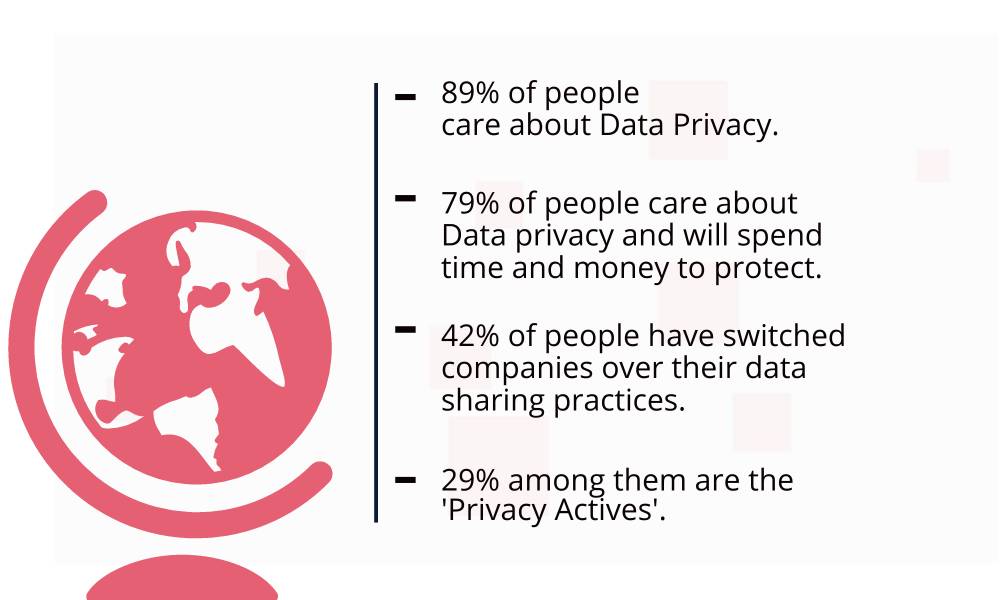
Here are some insights into why SurveyMonkey is not the best if you look for secure customer surveys.
1. SurveyMonkey, by default, collects the IP addresses of their respondents:
Yes, SurveyMonkey allows the creator of the survey to store the IP addresses of the respondents by default and include them in their final reports. So when your customer finds out their IP addresses are being collected, it makes them feel a data breach in their personal digital space.
It is mentioned in SurveyMonkey's privacy policy that the user's Device and browser data will be collected to use their services. Device data means your IP address, operating system, device type, device ID/MAC address, system and performance information, and browser type. The respondent really doesn't know what else is being tracked under the hood for just responding to your survey. In such a case, do you think your customer will give you an honest answer to your questions? Most of them simply want to avoid responding at all.
2. SurveyMonkey fails the Transparency test:
If you are using a third-party survey platform, transparency is the major issue. When you look into SurveyMonkey's 'Terms of Service', they have clearly mentioned, "Our servers keep the record of log details every time a device accesses the servers." It makes it clear that SurveyMonkey technically now records your digital identity. You can build a survey with 100 plus question types, easy third-party integration, etc., but what's the use of it without data privacy for your end-user.
If you are using it to collect your customer response, and if your customer is among the 'Privacy actives' ( people who switch companies for their mismanaged data privacy policies), you will definitely lose the digital trust of this group. It is even more evident from the recent Cisco survey that 21% of the people state that the companies should be responsible for protecting data privacy.
Though SurveyMonkey doesn't explicitly share these records with anyone, they are still stored on their servers and accessible to their staff. So, where's the logic of transparency with the end-user.Technically, if you fail to be transparent about how your respondent's data is being collected and used, then you should definitely go with our recommendation for a better and secured alternative for SurveyMonkey.
3. Is SurveyMonkey anonymous:
Being the pioneers of digital surveys, most people tend to choose them for their business survey needs.It is a common misconception that SurveyMonkey does not know anything in their surveys or on their website. But on the other hand, SurveyMonkey's privacy policy states that the reason behind collecting the IP address of their respondents is to avoid duplicate submissions. So it is self-evident that with SurveyMonkey, neither the creator nor the respondent can be anonymous. The real fix is simpler than SurveyMonkey makes it sound: don't collect identifying data in the first place. BlockSurvey encrypts every response end-to-end on the respondent's device, so there's no IP address or personal identifier to track for "duplicate prevention." Respondents can stay anonymous by default, not as an afterthought. Here is our blog on"Is SurveyMonkey anonymous?" for more details.
Why teams are leaving SurveyMonkey
Beyond the day-to-day privacy issues above, a few specific, documented reasons keep coming up when teams evaluate whether to stay on SurveyMonkey:
- A 2018 data breach: unauthorized attackers accessed SurveyMonkey's servers and downloaded partial data backups for surveys conducted before May 3, 2018.
- SurveyMonkey links have been weaponized for phishing: security researchers (Abnormal Security and others) have documented Office 365 credential-phishing campaigns that abused legitimate SurveyMonkey survey links (targeting tens of thousands of users at a time) specifically because those links bypass email security filters. This is abuse of the platform by outside attackers rather than a breach of SurveyMonkey itself, but it's a recurring trust concern for anyone sending survey links to customers or employees.
- A "Warning" privacy rating: the Common Sense Privacy Standard flagged SurveyMonkey's data practices, including using respondent data for ad targeting and sharing data with third parties.
- HIPAA protection is Enterprise-only: if you're collecting health-related feedback, a signed BAA and PHI-grade safeguards aren't available on Basic, Standard, Advantage, or Team plans, only on the custom-quote Enterprise tier.
- The free plan is too thin for real use: 10 questions per survey, only 25 viewable responses per survey, and no CSV/Excel/SPSS export at all, so you're pushed to a paid tier almost immediately.
- Pricing nudges you upward by design: the only month-to-month option, Standard Monthly ($99/mo, $1,188/yr), costs roughly 2.5x the annualized Advantage plan ($468/yr) for less capability, and reviewers explicitly call this out as poor value.
Pros and cons: SurveyMonkey vs BlockSurvey
SurveyMonkey
Pros: intuitive drag-and-drop survey builder consistently praised on G2 and Capterra; strong built-in analytics and reporting; a large template library covering most common use cases; high brand recognition and broad integrations with CRMs, Slack, and other business tools.
Cons: confusing, expensive pricing structured to push upgrades; free/Basic tier is too limited for real work (10 questions, 25 viewable responses, no export); advanced logic and custom branding are locked behind paid tiers and are reportedly difficult to configure; HIPAA-grade protection only on Enterprise; a "Warning" privacy rating over ad-targeting and third-party data sharing.
BlockSurvey
Pros: every response encrypted end-to-end, so even we can't read your data; no ad-targeting business model built on respondent data; anonymity by default rather than as an add-on; you hold the keys and own your data completely.
Cons: a much smaller template and integration ecosystem than an incumbent like SurveyMonkey, and less brand recognition. Teams that need the deepest analytics or the widest range of ready-made templates today may still need to check current plan details against their exact requirements.
Verdict: who should use which
Best for SurveyMonkey: teams running general-purpose surveys who want mainstream analytics, a wide template library, and standard third-party integrations, who are comfortable committing to an annual plan, and who aren't handling health, HR, or other sensitive data on a non-Enterprise tier.
Best for BlockSurvey: teams collecting sensitive, regulated, or personally identifiable feedback (HR, whistleblower, healthcare-adjacent, or any customer feedback) where "even we can't read your responses" needs to be a literal, structural guarantee rather than a policy promise, without needing an Enterprise-only quote just to get basic protection.
So do you wonder what the solution to your problem is? Here's our recommendation for a more secured survey platform trusted by companies to provide a better survey experience for you and your customer. BlockSurvey. This could be a great option when you care about the data privacy of your customer and a great user experience.
What is the most secure SurveyMonkey alternative available?
The answer is 'BlockSurvey.' BlockSurvey is the most trusted and secure online survey tool and the best available alternative for SurveyMonkey with all the key features. When websites like SurveyMonkey work as a profiling system to collect their users' data from behind, BlockSurvey is the first online survey platform that gives you complete control over your data. We strongly believe that owning your data is your fundamental digital right. Using BlockSurvey for your survey needs, you take complete control of your and your customer's data privacy. Our survey templates are created to give your respondents a better user experience with complete data protection.
Why BlockSurvey?
BlockSurvey encrypts every response end-to-end on your device, so even we can't read your data. Surveys created using BlockSurvey are always secure and data protected. BlockSurvey never stores, shares, or publishes your data in any way. You own your data completely, and it is accessible only to you since it is end to end encrypted using your keys. Unlike SurveyMonkey, you can maintain your digital trust with your customer and protect them from Surveillance Capitalism. Start your free trial now.
Ready to switch? Compare SurveyMonkey vs BlockSurvey side by side, or migrate from SurveyMonkey in minutes. See BlockSurvey pricing for current plans.
Related: See the best SurveyMonkey alternatives.
To Ensure The Privacy Of Your Customers, You Must Stop Using SurveyMonkey For Your Business FAQ
Is SurveyMonkey safe for collecting sensitive data?
Is BlockSurvey a good SurveyMonkey alternative?
Why should businesses stop using SurveyMonkey?
Is BlockSurvey more affordable than SurveyMonkey?
Get insights.
Unlock value.
- 14-day free trial
- Set up in minutes
- End-to-end encrypted