


.svg)



The terms 'Data Lookup' and 'Embedded Data' can be used interchangeably.
If you manage retail store inventory, you probably measure the stock at your store every month. A "Monthly Inventory Check Survey" is one way to do it. But when that survey asks your store staff to fill in details you already have, like the product name and unit counts, you create repetition and frustration.
Without a Data Lookup or Embedded Data feature, you waste staff time and risk inconsistent data entry that can throw off your inventory analysis. BlockSurvey's Data Lookup handles this. Data Lookup auto-fills survey fields from existing data, such as a spreadsheet, based on a unique identifier.
The feature lets you build more personalized surveys with less manual work.
This page covers how to set up and use Data Lookup or Embedded Data in BlockSurvey. First, why it matters in surveys.
Why Data Lookup or Embedded Data matters in surveys
The data source works like a database, and Data Lookup lets you retrieve data by querying it. This helps in a retail store where managers track available stock every month. In an Inventory Check Survey, Data Lookup lets you compare last month's stock count with the current count, so the store manager can see what changed. That comparison is one of the main benefits of the feature.
-
Personalizes the Experience: Store staff see inventory surveys that feel tailored to them. With a staff ID, you can address each person by name, which improves engagement.
-
Saves Staff Time: Your store staff do not re-enter information you already have, such as product name, product category, and inventory details. This reduces friction during inventory management at retail stores.
-
Improves Data Accuracy: Pre-filled responses remove typos and inconsistencies during data collection. That keeps your inventory data cleaner and more reliable.
-
Enables Conditional Logic: You can trigger different survey paths based on the data fetched from the source. Staff in a specific branch can be shown only the questions that apply to them.
-
Streamlines Survey Workflows: Data Lookup simplifies survey workflows. For retail stores, that includes the monthly inventory survey process.
How to set up Data Lookup or Embedded Data in BlockSurvey
Follow these steps to set up Data Lookup in BlockSurvey.
- Go to the Design screen of your survey and design your questionnaire. In this example, we are creating a questionnaire for a Monthly Inventory Check Survey.
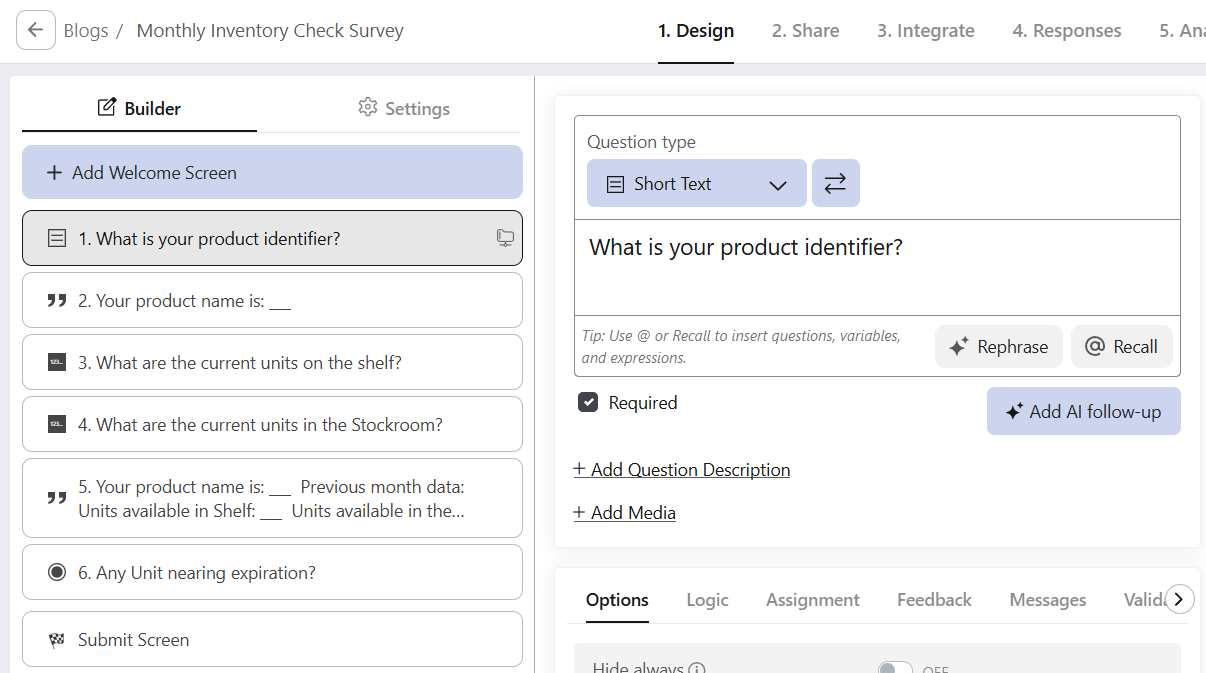
- Then, navigate to Settings -> Assignment & Formulas -> Data Lookup. Click Add Data Lookup
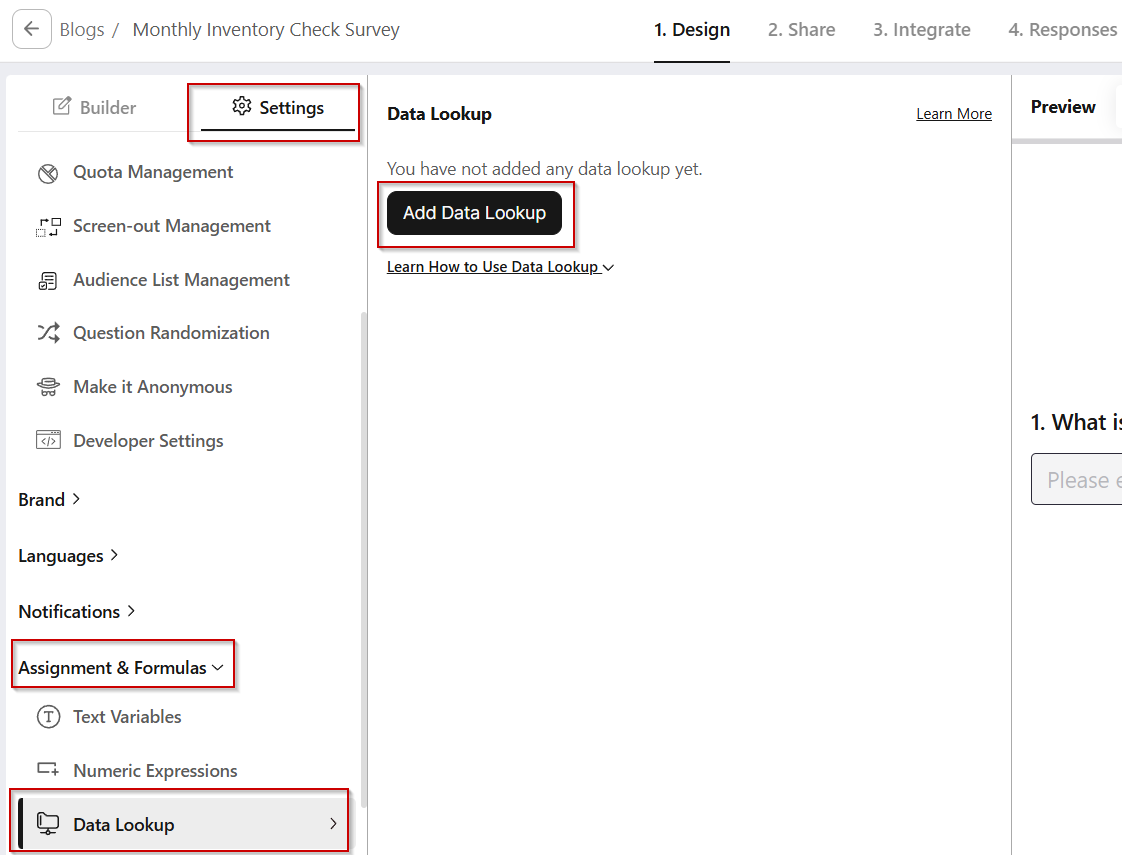
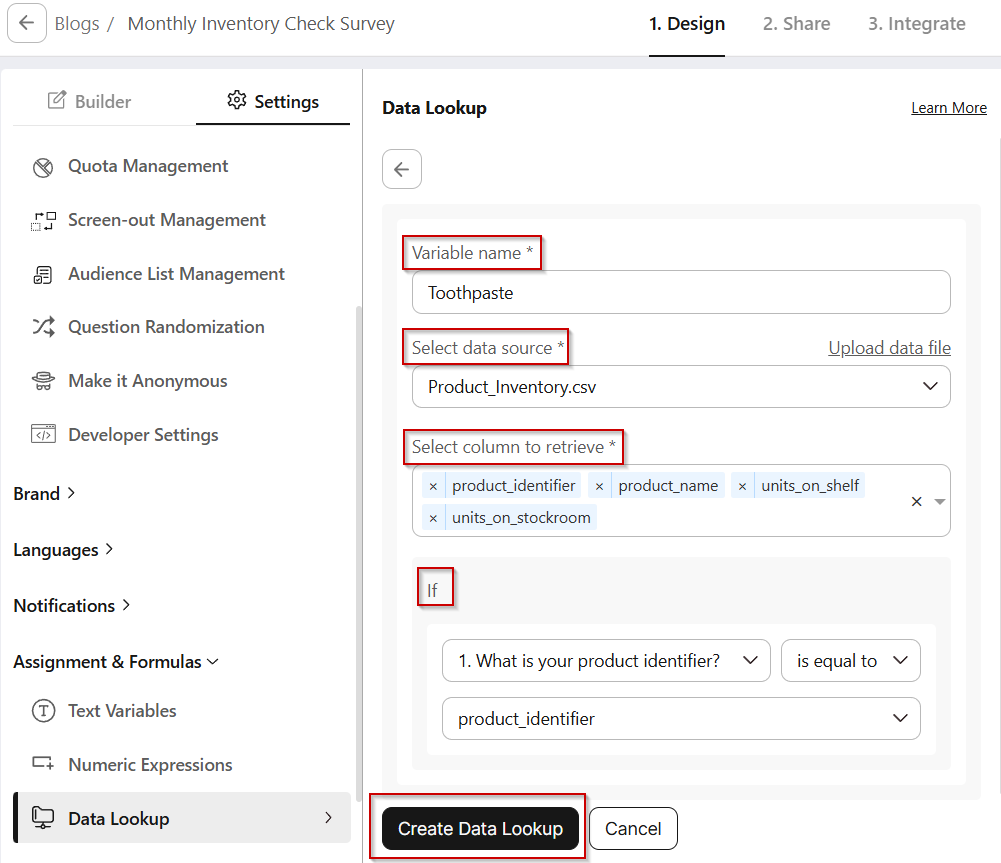
- Upload a data source file (CSV format) that contains the information you want to refer to. In this case, we are referring to the previous month's product inventory for toothpaste.
- Set up the lookup conditions:
- Enter a Variable Name to store the retrieved data.
- Select a Data Source from the list of uploaded files.
- Choose a Column to retrieve from the file to display on the survey. Multiple columns can be selected
- Set up conditions under Look up the data if:
- Select a column from the file to match against a survey question.
- Choose an operator (equal to / is not equal to).
- Select a question from the survey to compare the data.
- Multiple conditions can also be added. Click Create Data Lookup to save the setup.
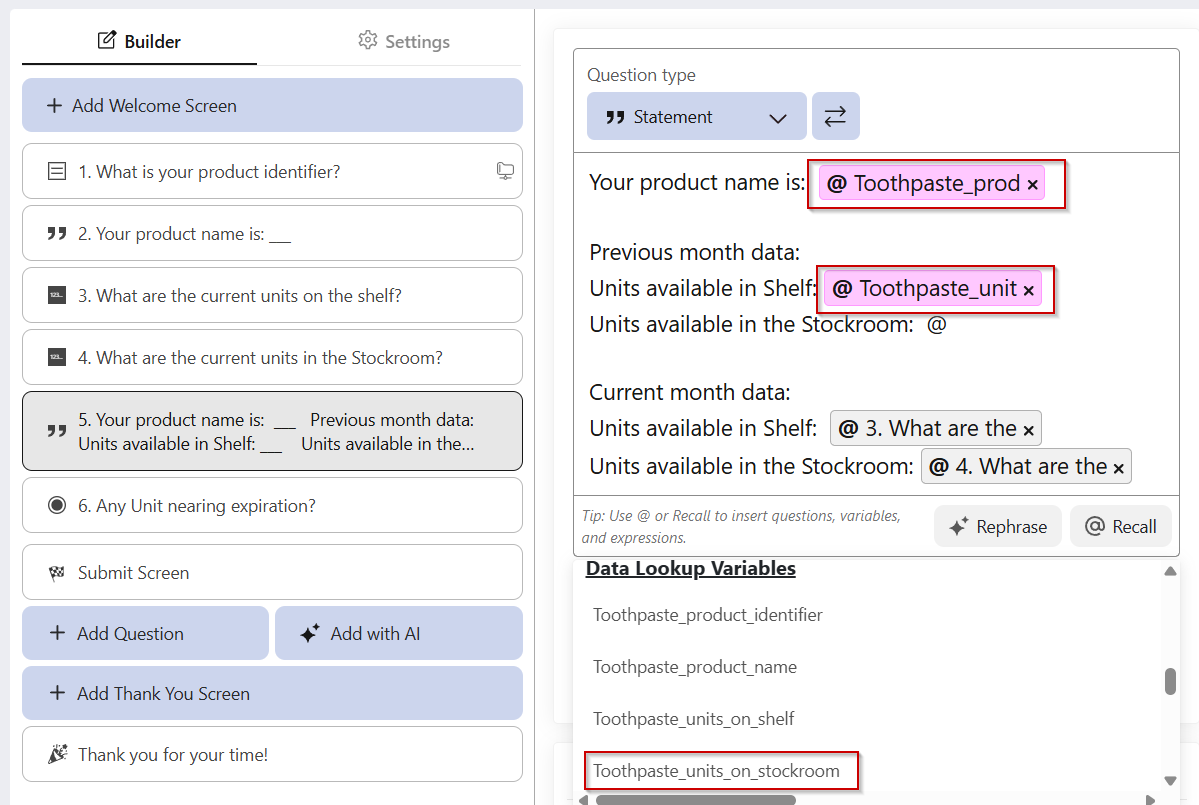
- Now, recall the Data Lookup variable in a question by clicking Recall or typing @ to select the variable under the Data Lookup Variables section.
- Publish the survey and test Data Lookup.
How Data Lookup or Embedded Data works in BlockSurvey
This example shows how Data Lookup works in a survey.
In our example, we uploaded a file containing Product identifier, Product name, Units on Shelf, and Units on Stockroom. You can set up a Data Lookup variable to retrieve the Product Name and Unit details based on the Product ID the respondent enters.
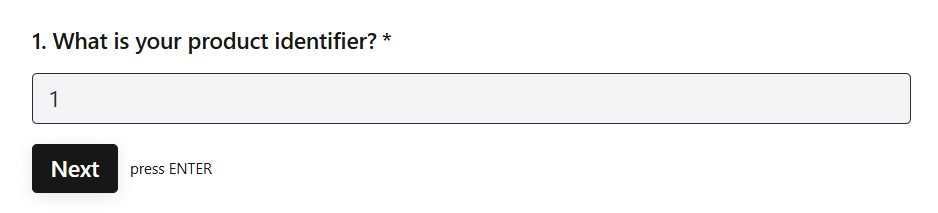
If the Product Identifier matches an entry in the uploaded file, the corresponding Product Name will be displayed.

Data Lookup can also pull last month's units and compare them with this month's, so you can see how the product units changed over time.
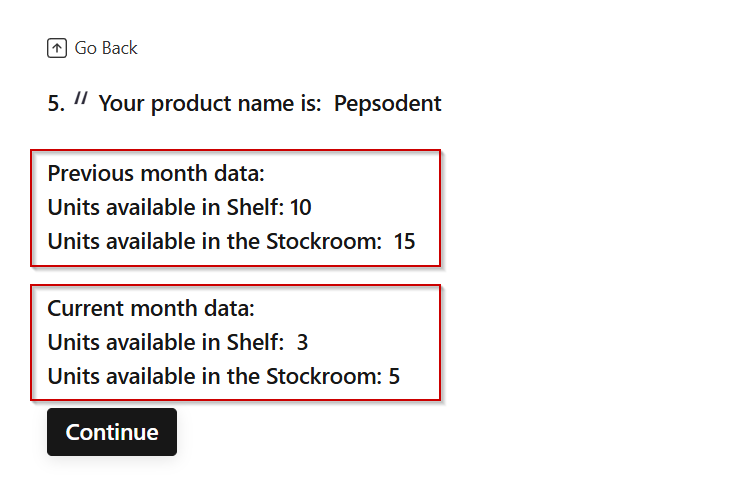
You can use it to personalize questions or auto-fill details, which makes surveys faster to complete and easier to manage.
Other use cases for Data Lookup in surveys
Here are a few other practical use cases for Data Lookup in surveys.
Customer Feedback & Onboarding
- Pull the customer's name and subscription status using email.
- Customize survey flows for premium vs. free-tier users.
- Reduce survey fatigue by skipping known details.
HR & Employee Surveys
- Auto-fill employee name, department, and manager based on email ID.
- Personalize performance reviews or engagement surveys.
- Skip irrelevant sections based on role or location.
Education & Academic Research
- Pre-fill student name, course, and year using student Identifier.
- Deliver different survey questions based on the enrolled program.
- Use roll numbers to verify eligibility for feedback collection.
Healthcare & Patient Intake
- Pre-fill patient details from appointment data.
- Show department-specific consent forms or feedback sections.
- Link surveys to case IDs for better data management.
Events & Community Engagement
- Auto-populate attendee info from registration lists.
- Display session-specific feedback questions.
- Identify no-shows and gather targeted feedback.
Conclusion
Data Lookup or Embedded Data in BlockSurvey does more than save a few clicks. It simplifies your survey workflow, cuts data-entry errors, and gives respondents a more personalized experience.
For large-scale retail inventory surveys that analyze product stock, Data Lookup keeps the survey faster to fill out and more accurate.
Try BlockSurvey's Data Lookup / Embedded Data today to change how you collect and manage data.
Explore related BlockSurvey features: repeating questions and question & answer piping.
How To Use Data Lookup or Embedded Data In Surveys? FAQ
What is a Lookup in data?
How does Data Lookup improve survey experience?
What identifiers are typically used for Data Lookup?
Can Data Lookup be used to conditionally display questions?
Get insights.
Unlock value.
- 14-day free trial
- Set up in minutes
- End-to-end encrypted