


.svg)



When a survey targets developers or other technical people, you usually want responses from active contributors, not anyone who happens to open the link. BlockSurvey's GitHub Identity Verification question type and the Social Gating feature let you validate respondents by their GitHub activity, so your survey reaches the people you actually want to hear from.
GitHub Identity Verification
The GitHub identity verification question type lets respondents verify their GitHub profiles inside the survey. Only users with a verified GitHub account can take part, which adds credibility to the data you collect.
GitHub Social Gating
Social gating goes a step further by letting you set conditions respondents must meet based on their GitHub activity. You can require a certain follower count, a minimum account age, or a level of involvement measured through starred repositories, so you reach the audience you have in mind.
Why it matters in forms and surveys
- Precise targeting: Reach the audience you need by filtering respondents on their GitHub activity.
- Better data quality: Let only respondents with relevant engagement take part, which improves the data you gather.
- Verification without manual work: GitHub profiles are checked automatically, so you save time and avoid the errors that come with manual checks.
How to collect GitHub identity and set up GitHub social gating in BlockSurvey
Setting up GitHub social gating gives you control over who can take part in your survey. Here is how to do it.
Step 1
Add the GitHub verification question to your survey. This question type lets respondents verify their GitHub profiles and collects identity details such as Username, Account Created At, Followers Count, Following Count, Bio, Public Repositories, and Account URL.
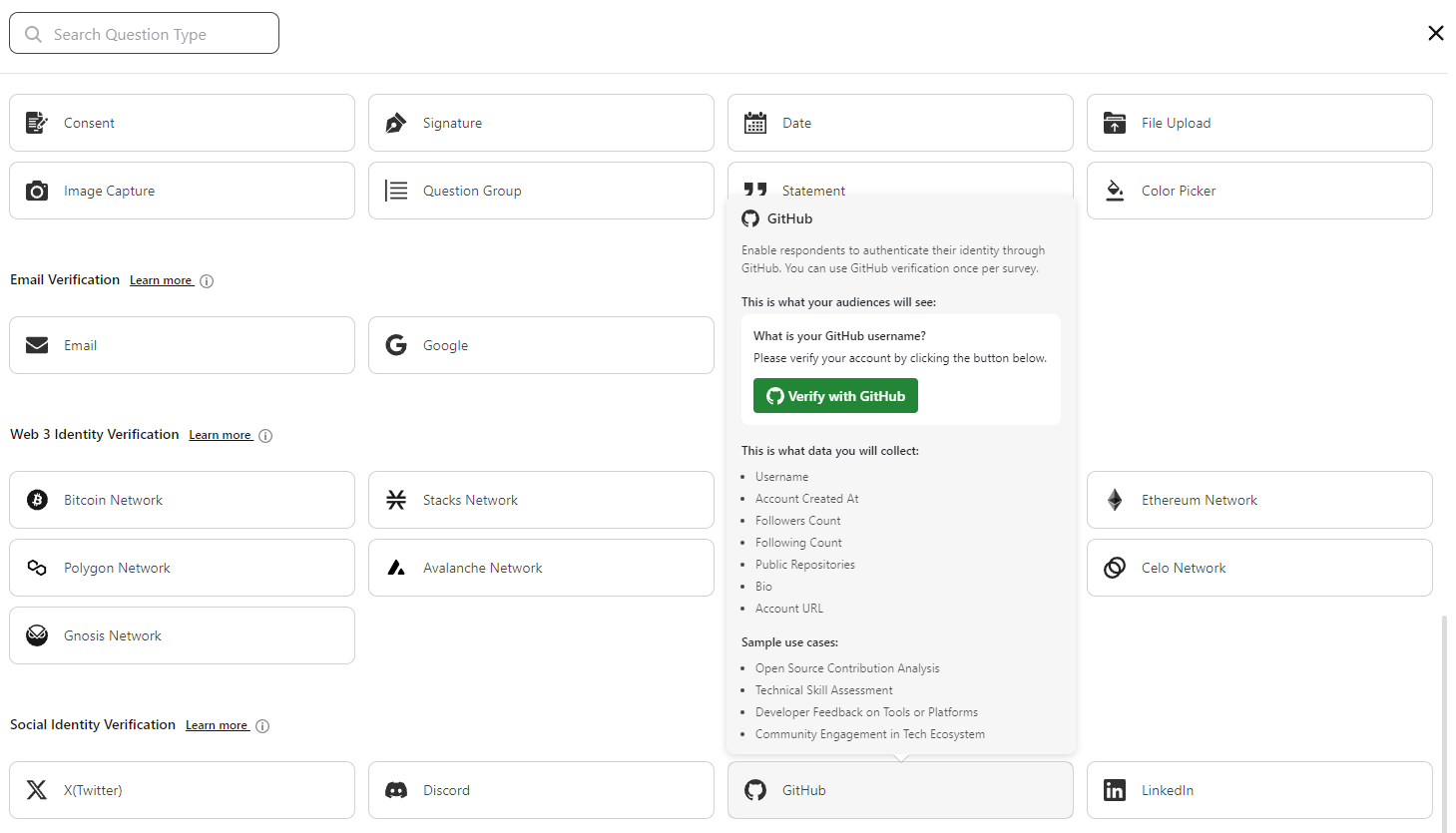
Step 2
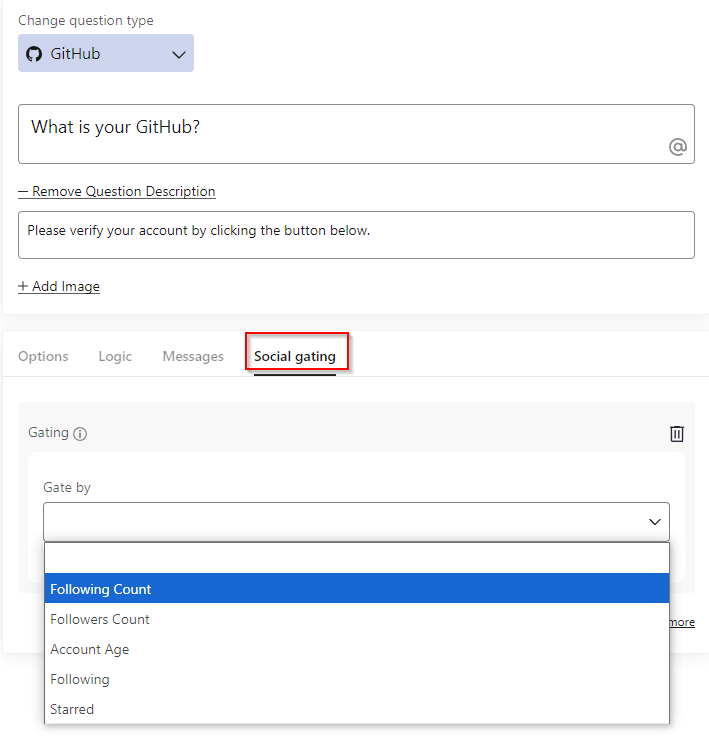
Once the GitHub question is added, go to the Social Gating tab and click "Add Gating" to define the conditions respondents must meet. You can set criteria such as following count, followers count, account age, repositories starred, or people they follow. Adjust these conditions to match what your survey needs so you reach the right audience.
Step 3
Submit test responses to see how it works before you make the survey live. Only respondents who meet the conditions can move to the next question or submit the survey, so only qualified participants add to your data.
Adding this feature strengthens your survey's data quality and helps you target the right audience, which makes your surveys more effective.
Use Cases
- Developer surveys: Filter participants down to those who actively contribute to open-source projects or have a real presence on GitHub.
- Community engagement: Confirm that respondents are part of your GitHub community by gating questions on their follower or following count.
- Product feedback: Gather input from users with a track record of starring repositories or following specific accounts, so the feedback comes from a knowledgeable audience.
Conclusion
BlockSurvey's GitHub Identity Verification and Social Gating feature help you target and engage the right survey participants. That improves both the precision of your data collection and the quality of the insights you get. Whether you want to filter developers, engage a tech community, or collect product feedback, this feature gives you a practical way to reach the right audience. With GitHub verification and gating, you can be confident that your surveys are answered by people who are genuinely engaged and knowledgeable, which leads to more accurate and useful results. If you want to refine your survey process and get better results, try the GitHub identity verification and social gating feature in BlockSurvey. You can also combine GitHub gating with email verification or token-gated forms for stronger respondent validation.
How to gate your forms & surveys using GitHub Identity? FAQ
Why is GitHub verification important in surveys?
How do I enable GitHub identity verification in BlockSurvey?
Does GitHub Social Gating improve survey quality?
Get insights.
Unlock value.
- 14-day free trial
- Set up in minutes
- End-to-end encrypted