


.svg)



On BlockSurvey, your surveys stay secure and private, and your data is protected from leaks and breaches.
Public concern about data security and data protection keeps rising. Survey respondents who share their data with market research firms or give feedback to their employers feel the same way.
Improving the security of your survey data and giving respondents peace of mind helps you collect better data and raise response rates. BlockSurvey is built for that.
BlockSurvey: a secure survey tool
BlockSurvey is a private and secure survey tool, built to give participants full anonymity, privacy, and security. It protects your respondents and keeps their data from being misused or compromised, and it does all of this without leaving a digital footprint.
You can run every kind of sensitive survey on BlockSurvey, including employee satisfaction questions, customer surveys, mental health surveys, and any other sensitive data collection, and keep the whole thing secure.
How BlockSurvey uses blockchain to create secure forms & surveys
Strong encryption and decentralized storage can change how businesses protect survey data, yet very few survey tools use them. BlockSurvey does today. BlockSurvey uses the Stacks blockchain, which is secured by Bitcoin, to run your surveys.
Two blockchain features make secure forms & surveys possible.
- Decentralized Identity(DID) and Auth: The account you create with BlockSurvey is a Decentralized Identity bootstrapped from Bitcoin. You get a seed phrase on creating an account, which is your secret key to the account. Only you know it, not BlockSurvey and not anyone else. It works like holding the keys to your own house, but for the digital world. That is the core of the security. Each time you log in, you are authenticated on the blockchain, and no one can lock you out.
- Decentralized Storage: All your data collected is encrypted using your public keys and is stored in the decentralized storage, and only your keys can unlock it. Because you own your account, identity, and data, you keep your digital rights. This prevents data breaches, leaks, and harvesting, and it removes the question of who to trust. We think using blockchain to launch secure forms & surveys will change how surveys are conducted and become a standard tool for every data collector.
Secure survey features in BlockSurvey
- Decentralized Identity and Auth: A world without passwords is hard to picture, yet cutting our
reliance on so many of them is smarter, safer, and the better practice. The internet was built as an open,
interoperable space where data can flow freely. Getting there meant creating a way to authenticate users, which
raised a fair question about how secure that data really is. Decentralized identity (DID) and auth answer it.
BlockSurvey uses Stacks Auth for this.
- Decentralized Storage: Cloud storage carries more risk than local storage. Storing files and photos on a cloud platform puts them in someone else's hands. Cloud storage has advantages, but also risks worth watching. Decentralized storage is one alternative. BlockSurvey stores your data in a decentralized store called Gaia. It is accessible only to you, and all of it is encrypted. Only you can reach it. Not even BlockSurvey can.
- Custom SSL: Custom SSL and HTTPS on your website are the first step to a secure connection between your survey URL and your respondents. With BlockSurvey, every survey URL has SSL enabled and is served over HTTPS by default. HTTPS (HyperText Transfer Protocol Secure) is the secure version of the HTTP protocol that transfers data between your browser and the website you are connected to. HTTPS adds a protection layer by encrypting data transmitted over the internet. Also Read: White Label Surveys.
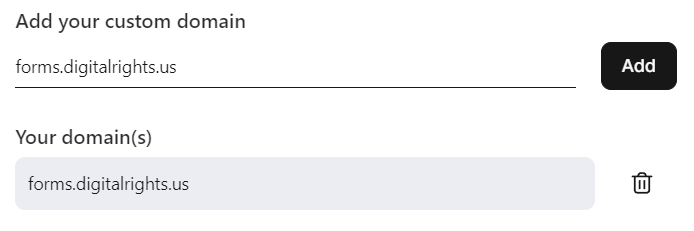
- Custom Domain: A custom domain tells your respondents that their information is safe and shows who they are dealing with. Much like blogging platforms that let you host your blog on your own domain, BlockSurvey lets you set an owned custom domain for your survey URLs. This is also called URL white-labeling in surveys. By default, your custom domains are protected using dedicated SSL certificates from Let's Encrypt.
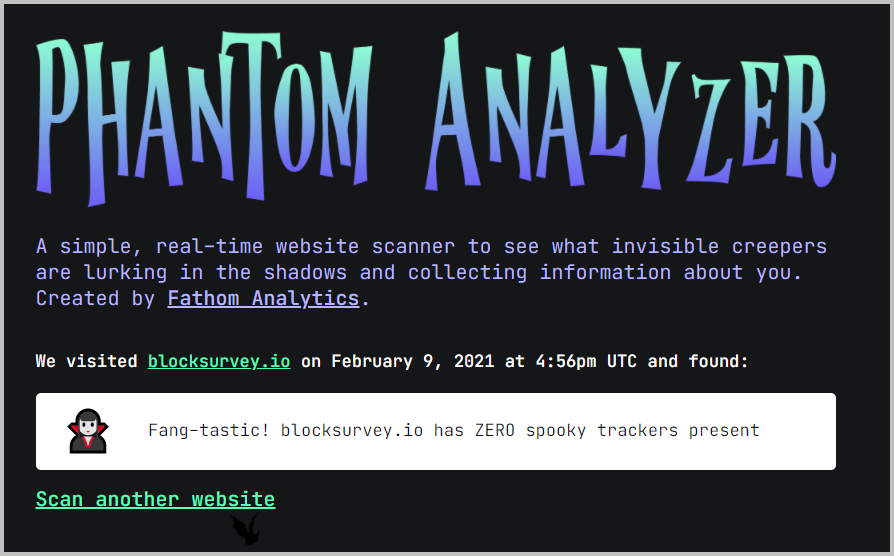
- Privacy: Secure survey links also keep respondents anonymous. They usually do not store IP or geolocation data, which suits research projects whose success depends on assuring respondents that their answers stay anonymous. There are no trackers, analytics, cookies, or fingerprinting, and no IP address collection, so every respondent is anonymous to you. That is what makes anonymous surveys possible. People run surveys anonymously for many reasons. An Employee satisfaction survey, for example, gives employees a private, safe space to share feedback without fear of being punished for their honesty. Educational and medical research often needs the same privacy. BlockSurvey also stores very little user data. Every survey is set to 'no-index' by default, so search engines can never index your surveys. None of the data is shared with Big Tech. You can check the analytics here: https://usephantom.com/blocksurvey.io
Takeaway: the need for secure surveys
We think using blockchain to launch secure surveys will change how surveys are conducted and become a standard tool for every market researcher, whatever their budget. This end-to-end encrypted approach keeps trust, security, and privacy at the center of every survey. BlockSurvey is here to do that in the survey space.
Also Read: How to do Confidential Surveys?.Secure Survey Software Compared
The table below compares BlockSurvey with Google Forms, Qualtrics, and SurveyMonkey on the four controls that decide how secure a survey really is: end-to-end encryption, who owns respondent data, whether responses are anonymous by default, and which compliance standards are supported. Competitor entries reflect each vendor's own published documentation.
| Platform | End-to-end encryption | Respondent data ownership | Anonymity by default | Compliance |
|---|---|---|---|---|
| BlockSurvey | Yes. Responses are encrypted with your public keys, and only your keys can unlock them, so BlockSurvey cannot read them. | Yes. You own your account, identity, and data through a seed phrase that only you hold. | Yes. No trackers, cookies, fingerprinting, or IP address collection, so every respondent is anonymous to you. | HIPAA, GDPR, SOC 2, ISO 27001, and FERPA. |
| Google Forms | No. Google encrypts data at rest and in transit, but Google manages the keys and can access responses. | No. Responses are stored in the creator's Google Drive and Sheets under Google's infrastructure. | No. Anonymity is a per-form setting; the creator can require sign-in or collect email addresses. | HIPAA only on a paid Google Workspace plan with a signed BAA; GDPR is covered under Google Workspace terms. |
| Qualtrics | No. Qualtrics documents TLS encryption in transit; end-to-end encryption is not documented. | No. Qualtrics stores and processes respondent data on its platform. | Not by default. Anonymous survey links are available as a configuration option. | SOC 2 Type II, ISO 27001, HITRUST (supports HIPAA), and FedRAMP Authorization; GDPR request tooling. |
| SurveyMonkey | No. SurveyMonkey uses AES-256 at rest and TLS in transit, but holds the keys and can access data. | No. SurveyMonkey stores and processes respondent data on its platform. | Not by default. Administrators can restrict PII collection to keep responses anonymous. | SOC 2, ISO 27001, and PCI DSS; HIPAA is available on the Enterprise product with a BAA. |
Compliance Support
BlockSurvey supports HIPAA compliance alongside GDPR, SOC 2, ISO 27001, and FERPA, while keeping end-to-end encryption in place for every survey.
HIPAA
Because responses are encrypted with keys that only you hold, protected health information stays unreadable to BlockSurvey. This design supports HIPAA requirements for collecting health data without exposing it to the platform.
GDPR
BlockSurvey collects no trackers, cookies, or IP addresses, so respondents stay anonymous and the volume of personal data you hold is minimized. This aligns with GDPR principles of data minimization and privacy by default.
SOC 2
BlockSurvey supports SOC 2, the standard that covers security, availability, and confidentiality controls, so teams with vendor security reviews can adopt it for sensitive data collection.
The importance of using secure survey software FAQ
What is secure survey software?
What survey apps are safe?
Is Qualtrics more secure than Google Forms?
How do you keep surveys confidential?
What survey tools are HIPAA compliant?
Get insights.
Unlock value.
- 14-day free trial
- Set up in minutes
- End-to-end encrypted