


.svg)



You've built a survey to gather insights from your target audience. Each question is written to capture a clear response, and you're ready to analyze the data for trends and patterns. Without proper quota management, though, that effort can produce a lopsided dataset.
For example, imagine you're working with a panel provider to run a market research survey on consumer preferences for a new fitness app. You want responses from a balanced mix of age groups and genders. Without quota management, you might get 70% of your responses from young adults aged 18-24 and only 30% from other age groups, with far more female respondents than male. That imbalance skews your data and makes it hard to draw accurate conclusions about overall consumer preferences. BlockSurvey's "Quota Management" feature is built to fix this.
Quota management controls the number of responses so your data stays balanced and representative.
Why it matters in surveys and forms
- Avoiding Bias: Without quotas, your data can end up biased, which skews results and leads to inaccurate interpretations. Quotas reduce that bias by keeping responses diverse.
- Control Over Sample Size: Quotas let you control how many responses come from each group in your target population. This prevents oversampling of one group and keeps every relevant segment adequately represented.
- Representativeness: Quotas keep the responses you collect in line with the demographics or characteristics of the population you're studying. When you set quotas based on factors like age, gender, and location, your sample reflects that population.
- Accuracy of Insights: A balanced, diverse set of responses improves the accuracy of the insights and conclusions you draw from the survey or form data.
How to set up quota management in BlockSurvey
BlockSurvey offers two types of quota management, depending on what you need:
- Overall Quota: Set at the survey level. It limits the total number of completed responses for the entire survey.
- Logic Quota: Lets you collect responses from a specific subset of respondents based on logic conditions you define.
Setup Overall Quota
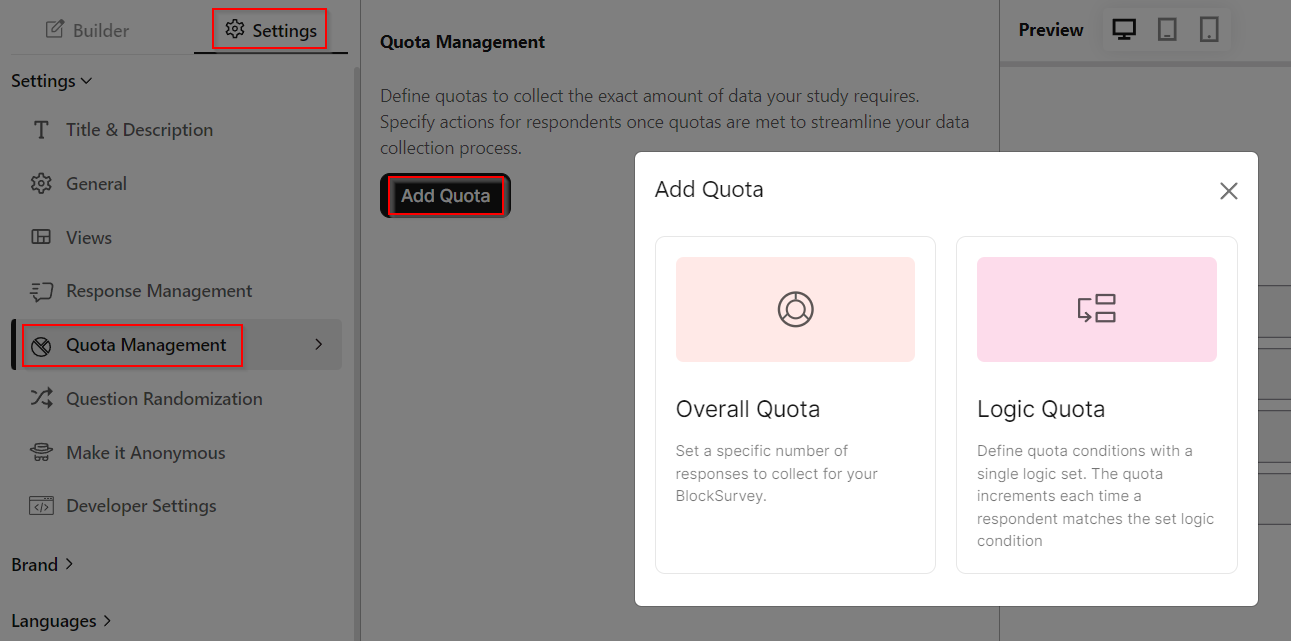
- Go to Settings -> Quota Management in your survey.
- Click on Add Quota and select Overall Quota.
- Name the quota and enter the maximum number of responses you want to collect for the entire survey.
- Choose the action to take once the limit is reached:
- End Response Collection: No more responses are collected once the limit is reached.
- Continue Response Collection: New responses are still collected after the limit, but they are saved under Disqualified Responses on the Responses screen.
- Customize End of Survey Collection:
- Redirect to a Thank You screen.
- Display a default message.
- Display a custom message (e.g., "Thank you for participating!").
- Redirect to a URL (e.g., your website).
Note: The Overall Quota can only be set once per survey.
Setup Logic Quota
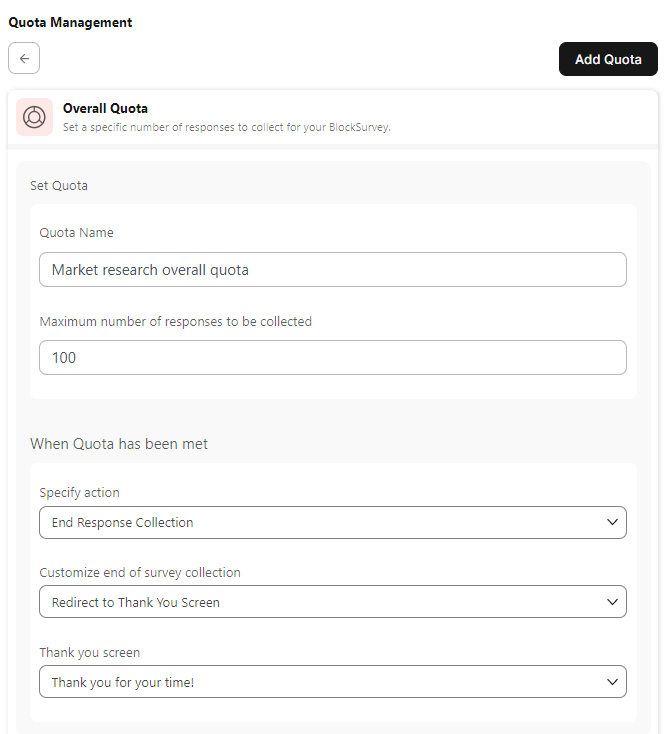
Here is the Logic quota with an example. You are running a market research survey and want responses from an equal number of male and female participants. You want to cap the total at 200 responses, with 100 from each gender. To set up the logic quota:
- Go to Settings -> Quota Management in your survey.
- Click on "Add Quota" and select "Logic Quota".
- Name the quota "Gender Quota". Set the maximum number of responses to 200.
- By default, the "Set percentage for quota" option is enabled.
- Click on "Add Quota Logic" to define your logic conditions.
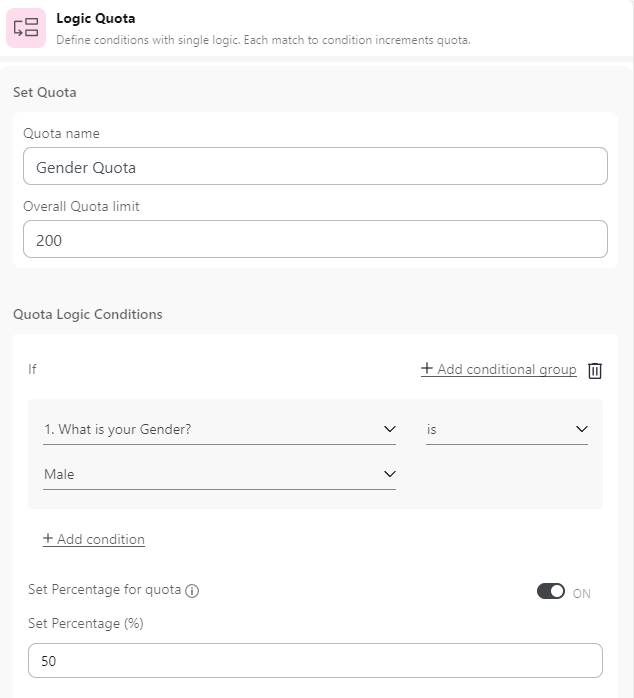
- Define quota logic for male and female respondents by adding separate Conditional groups in the same Logic Quota.
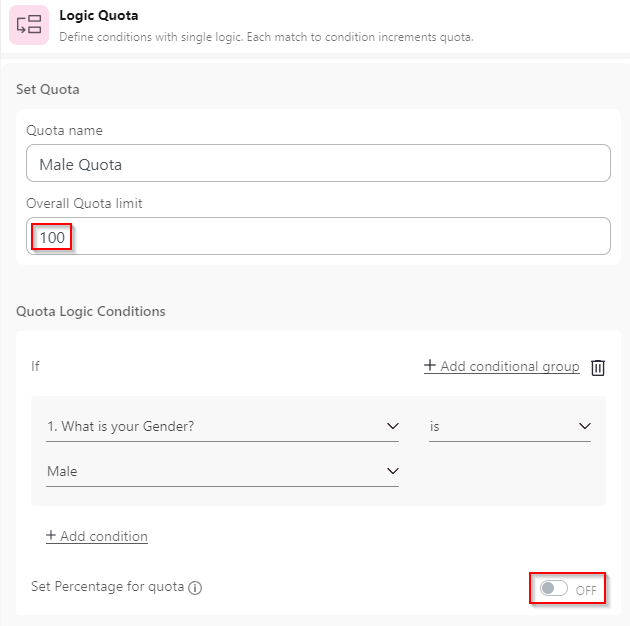
- If you know the exact count, disable the "Set percentage for quota" option, define a quota logic, and set the desired count.
- Choose the action to take once the limit is reached:
- End Response Collection: Stop collecting responses once the response limit is reached.
- Continue Response Collection: Keep collecting responses, but categorize them under "Disqualified Responses".
- Customize End of Survey Collection:
- Redirect to a Thank You screen.
- Display a default message.
- Display a custom message (e.g., "Thank you for participating!").
- Redirect to a URL (e.g., your website).
Quota Management vs. Screen-out Management
1. Purpose and Application:
- Quota Management keeps the survey's responses balanced and representative according to the quotas you set. You use it to control how many responses come from specific demographic groups, such as age, gender, or location, so no group is over-represented.
- Screen-out Management filters out respondents who don't meet specific criteria based on their answers to screening questions. It lets only relevant respondents proceed, which improves the accuracy and relevance of the data you collect.
2. How It Works:
- Quota Management: Works by setting limits (quotas) on how many responses can come from specific groups. Once a quota is filled, no more responses are accepted from that group, which keeps the data balanced.
- Screen-out Management: Works by setting conditions based on the answers to screening questions. Respondents who don't meet those conditions are screened out and cannot continue with the survey.
3. Focus on Respondent Qualification:
- Quota Management: Focuses on balancing responses across predefined groups. It does not filter out respondents based on specific answers.
- Screen-out Management: Focuses on qualifying respondents by their answers to screening questions, so only those who meet the criteria complete the survey.
4. Outcome:
- Quota Management: Controls the quantity and distribution of responses, so each segment of your target population is adequately represented.
- Screen-out Management: Filters out irrelevant respondents early, so the data you collect comes from your target audience.
Use cases for quota management
A few cases where it makes a difference:
- Market Research: Market research depends on insights from a diverse audience to understand different consumer behaviors and preferences. Quota management pulls responses from a range of demographic groups, giving you a fuller view of the market.
- Product Feedback Surveys: Say you're collecting feedback on a new software product. Quota management lets you hear from novice and experienced users in equal measure, so you understand different user perspectives and make product improvements that account for both.
- Customer Satisfaction: In a customer satisfaction survey, quota management makes sure feedback comes from customers across various regions and demographics. That helps you spot region-specific issues or strengths and base decisions on a representative sample of your global customer base.
- Election Polling: Polling agencies use quota management so their samples represent the voting demographics of different regions, age groups, and socio-economic backgrounds. This reduces bias and produces more reliable insight into voter preferences.
- Employee Engagement Surveys: Quota management matters here so feedback comes from employees at all levels of the organization, across departments and roles. That helps you identify department-specific concerns or strengths and build targeted improvement plans.
Conclusion
BlockSurvey's quota management feature improves the quality and reliability of your survey data. It gives you a practical way to keep responses balanced and representative, reduce bias, and improve the accuracy of your insights. By managing response quotas, you collect meaningful feedback from different segments of your audience, so your surveys reflect the real makeup of your target population and lead to better-informed decisions. If you want to tighten your response management process and get higher-quality data, try the quota management feature in BlockSurvey.
Explore related BlockSurvey features: skip logic and prevent duplicate submissions.
How to use quota management in surveys? FAQ
What is a survey quota?
How do survey quotas work?
What happens when a survey quota is met?
What are the different types of survey quotas?
What is the difference between quota management and screen-out management?
Why is quota management important in surveys and forms?
Get insights.
Unlock value.
- 14-day free trial
- Set up in minutes
- End-to-end encrypted