


.svg)



Respondents share sensitive, reliable information when they trust how their data will be handled. You can also raise confidentiality well beyond simply keeping identifiable data secret. BlockSurvey lets you build anonymous surveys, and this guide explains how to improve the confidentiality of your own surveys and why confidentiality matters.
What are confidential surveys?
A confidential survey is an online survey that does not ask for the participant's name. If the respondent answers honestly, you see their answers but not who gave them. Confidential surveys work well when you want feedback from people without tying it to their identity. On sensitive topics, respondents often hold back honest feedback if they think their identity will be exposed.
Take an employee answering a survey. The data is usually linked or segmented: it is held privately but still connected to a person, often through a unique identifier. So the information is kept secret, but the individual is not unknown.
In a confidential survey the data is linked to the participant, so the terms of confidentiality matter a great deal. At BlockSurvey we understand how important confidentiality is, and we take extra steps to keep your data with you and no one else. BlockSurvey has zero knowledge of your data.
Why confidentiality is required and should be maintained in a survey
If you or your company plans to run online surveys, treat confidentiality as a critical consideration. Data collected from online surveys must be kept confidential. When you gather personal information through an online survey, make it clear what the information will be used for. Tell respondents you will not use their information for any purpose other than completing the study. If you intend to collect personal details and reuse them, inform the respondent and clearly give them a way to opt out.
Once you have earned your respondents' trust and shown them the survey is genuinely confidential, you will usually get more responses than you expected.
Can a survey be both confidential and anonymous?
Before you build the survey, decide whether it will be anonymous, confidential, or identified. You can read our article here on confidential vs anonymous.
When data is collected and held anonymously, there are no identifying values that can link the data back to a participant, and not even the researcher can identify a specific person. Online survey tools are usually run anonymously, but the researcher must make sure the IP address is not stored.
The researcher should also remember that too many identifying demographic factors can undermine participants' privacy. When information is collected and held confidentially, the researcher can identify the subjects. One way to do this is to assign an identifying number or code to each participant. Any study run face to face is automatically confidential, since the researcher knows who provided the information. Because confidential data is identifiable, it must be kept secure. As with anonymous data collection, it helps to tell participants that their information will be analyzed at the group level to de-identify them, and that identifying numbers will not appear in the results of the analyses.
What are the main advantages of using a confidential survey?
Confidential surveys have three main advantages.
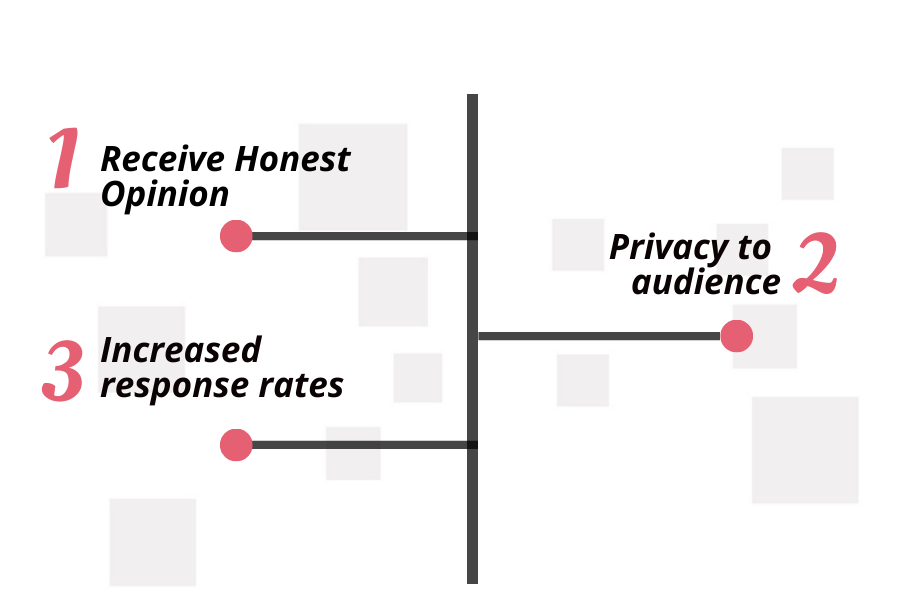
- Honest opinion: If you want raw, honest opinions from your customers or clients, a confidential survey is one of the most reliable ways to get them. The whole point is to make people feel safe about their identity so they answer openly.
- Privacy: Honest answers depend on protecting each respondent's identity. You keep collecting responses while making sure no one can trace or link participants to the answers they gave you or your company.
- Response rate: Confidential surveys are especially useful when you are asking about personal or sensitive topics. Knowing the survey is fully confidential makes respondents far more likely to reply, which raises response rates on surveys that might otherwise struggle to get them.
BlockSurvey: A confidential survey tool
A confidential survey tool is an online survey that protects your respondents' identities. It keeps private information from leaking or being disclosed to a third party through the respondents' involvement in your survey, which gives both you and your respondents peace of mind. That is why confidential survey tools are popular with people who want to avoid harm or protect themselves from an adversary. BlockSurvey helps you do this. You own your data with BlockSurvey, and only you can see it, thanks to end-to-end encryption and a privacy-first architecture that gives you full ownership of your responses. Learn how to collect data confidentially with BlockSurvey.
Here is an example of a sample confidentiality agreement form.
How to do a Confidential Survey? FAQ
What is a confidential survey?
What is the difference between anonymous and confidential surveys?
Are confidential surveys really confidential?
How do you create a confidential survey?
What are the disadvantages of anonymous surveys?
Can a company fire you for an anonymous survey?
How do you say a survey is confidential?
How can I increase participation in confidential surveys?
Get insights.
Unlock value.
- 14-day free trial
- Set up in minutes
- End-to-end encrypted