


.svg)



BlockSurvey is the top Qualtrics alternative for Institutional Research in 2026 for teams that want AI-native survey tools, transparent pricing, and true end-to-end encryption, without an opaque, custom-quote enterprise contract. QuestionPro remains the better pick if budget is the only constraint, and REDCap is still mandatory for IRB-regulated or health-data studies.
Over the past few months, I've spoken with dozens of Institutional Research professionals across universities in the US. What I kept hearing surprised me at first, then settled into a clear pattern, as almost everyone had the same conflicted relationship with Qualtrics.
Many still consider it a market leader, but a common refrain is that justifying the costly renewal to finance has become a bigger burden than the value they get from its features. This came up across institutions.
Qualtrics is seen as a powerful survey tool, yet the rising costs, rigid contract terms, and feature bloat are becoming harder to defend when Institutional Researchers are being asked to do significantly more with flat or shrinking budgets.
So I started asking: what are you actually testing? What's working? What would you recommend to a colleague at another institution who's in the same bind?
This blog is shaped entirely by those conversations, a practical list of the alternatives IR teams are actually considering beyond Qualtrics.
BlockSurvey vs Qualtrics at a Glance (2026)
| Axis | BlockSurvey | Qualtrics |
|---|---|---|
| Privacy / Compliance | End-to-end encrypted, so even we can't read your survey responses. HIPAA, GDPR, ISO 27001, and SOC 2 aligned. | Enterprise compliance certifications, but real exposure on record: a May 2024 breach at a Qualtrics customer (Blue Cross Blue Shield of North Carolina) let an unauthorized party use compromised credentials to access names, emails, demographics, and health-insurance data. Qualtrics (with Microsoft) also faces an active class action alleging its "Site Intercept" tool captured visitors' medical/prescription searches on a health system's site without consent. That is an allegation, not yet adjudicated. |
| Pricing | Transparent, flexible plans, no multi-year lock-in. See current plans at blocksurvey.io/pricing. | Free/Basic: $0. One published self-serve tier ("Strategic Research"): $420/mo billed annually. Everything else (CoreXM, CX, EX, Strategy & Research suites) is custom-quote only. Third-party buyer data (Vendr) puts the median deal at ~$28,533/year, ranging roughly $6,525 to $126,000/year, with small-enterprise CoreXM quotes commonly cited at $25K to $50K/year. Buyers frequently report a "land and expand" pattern where costs rise sharply after the first contract. |
| Free-tier limits | See current free-plan details at blocksurvey.io/pricing. | 500 total responses per user (including retaken/deleted ones), 30 questions per survey, only 3 active surveys at a time. Free accounts are deleted after 13 months of inactivity. |
| Customization | Advanced logic, white-labeling, and a dedicated IR template library. | Very deep customization (scripting, advanced branching, Stats iQ/Text iQ), but reviewers and buyer guides consistently flag a steep learning curve for non-researchers. |
| Integrations | 100+ apps including Power BI, Tableau, Zapier, Make, n8n, and Power Automate. | Broad enterprise integration ecosystem, though many connectors and SSO/data-residency options are gated behind higher, custom-quote tiers. |
| Reporting | AI-powered thematic and sentiment analysis on open-ended responses, built-in dashboards. | Powerful statistical depth (Stats iQ, Text iQ) suited to serious market research, though that power comes with real ramp-up time. |
| Self-host / Data ownership | Data is encrypted end-to-end before it's stored, so BlockSurvey itself cannot read your responses. No self-hosting option. | Cloud-hosted; enterprise data-residency options available on higher, custom-quote contracts. No self-hosting. |
Qualtrics on G2 & Capterra
G2: ⭐⭐⭐⭐☆ 4.4 / 5, aggregated across Qualtrics's product listings (Strategy & Research: 3,015 reviews; Market Research: 3,017 reviews; Customer Experience: 750 reviews; Employee Experience: 462 reviews; 4,286 total reviews on the aggregate seller profile).
Capterra: ⭐⭐⭐⭐☆ 4.6 / 5 for "XM for Customer Experience" (Ease of use 4.4, Customer Service 4.6; 255 verified reviews). "XM for Employee Experience" is listed separately (79 verified reviews). Capterra splits Qualtrics across multiple product pages rather than a single unified listing.
Why Institutional Researchers Are Leaving Qualtrics
The conversations kept circling back to the same handful of specific frustrations, not vague "it's expensive" complaints:
- Opaque, quote-only pricing: only the free plan and one $420/mo self-serve tier are published anywhere. Every other tier, the ones most IR offices actually need, requires a sales call, and buyers report a "land and expand" pattern where costs climb well past the initial quote.
- Steep learning curve: reviewers and buyer guides consistently describe the interface as overwhelming for non-researchers, with advanced tools like Text iQ and Stats iQ requiring significant ramp-up time before a team gets value from them.
- Feature overload: you're paying for a full enterprise XM suite (CX, EX, and Strategy & Research), commonly $25K to $50K+/year for small-enterprise CoreXM per Vendr's data, even if your office only runs course evaluations and campus climate surveys.
- A restrictive free/entry tier: 500 total responses, 30 questions per survey, and 3 active surveys make the free plan usable only for a small pilot, not real campus-wide work.
- A real, documented privacy incident: in May 2024, a Qualtrics customer (Blue Cross Blue Shield of North Carolina) had its account accessed via compromised credentials, exposing names, emails, demographic data, and health-insurance information, disclosed to the Montana Attorney General on July 19, 2024. Separately, an active class action alleges Qualtrics's "Site Intercept" tool, deployed with Microsoft on a health system's site, captured medical searches and prescription data without consent (an allegation still in litigation, not a finding of fact).
None of this means Qualtrics is a bad tool. Its statistical depth, enterprise trust, and support reputation (a 4.6/5 customer-service sub-score on Capterra) are real. It means the calculus for many IR offices has shifted: whether that depth is worth a five- or six-figure, opaque contract for surveys that don't need it.
1. BlockSurvey
BlockSurvey is an AI-powered Institutional Research Survey Software that covers the data collection cycle, including student experience, course evaluations, faculty satisfaction, and accreditation reporting. It pairs a simple design with privacy controls and automated analysis, so Institutional Researchers can collect and review responses faster, without the overhead.
With a library of Institutional Research templates, modern design options, and affordable pricing, BlockSurvey has become a practical, secure alternative to legacy tools like Qualtrics.
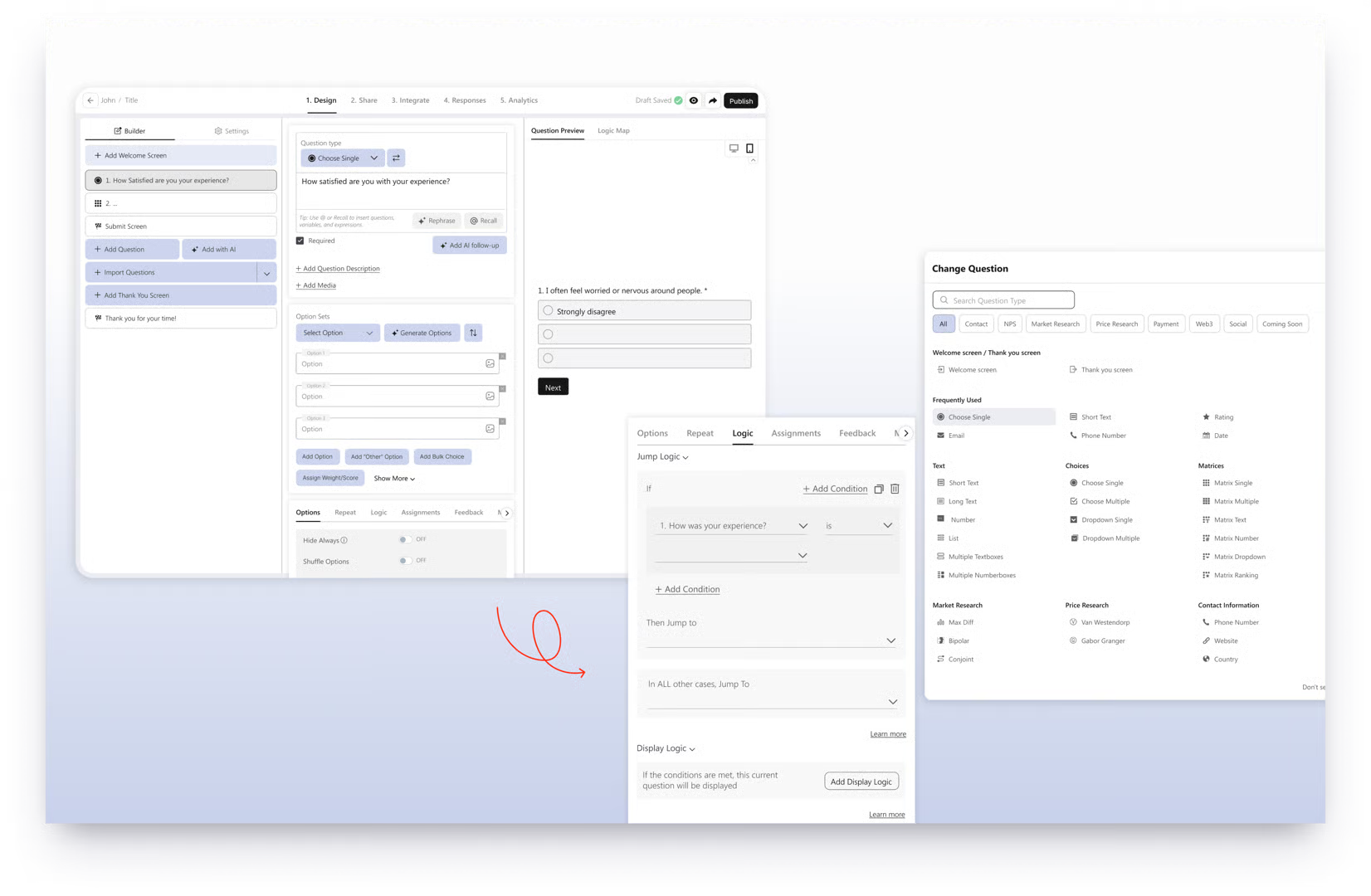
Why BlockSurvey is the best Qualtrics Alternative:
| Feature Area | BlockSurvey Advantage | Key Benefit for Institutional Researchers |
|---|---|---|
| AI at the Core | Generate surveys using AI & analyze open-ended responses in seconds with AI-powered thematic and sentiment analysis. | Cut the time spent on qualitative data and turn feedback into evidence for accreditation and reporting. |
| IR Workflows | Access advanced logic, white-labeling, and a library of IR survey templates (course evaluation surveys, campus climate surveys, student affairs surveys, etc.). | Standardize data collection cycles and improve response rates across campus with tools built for your specific needs. |
| Integrations | Integrate with 100+ apps like Power BI, Tableau, and automation tools (Zapier, Make, n8n, Power Automate). | Simplify analysis and reporting by sending data directly to your existing tech stack. |
| Cost and Flexibility | Transparent, flexible pricing plans without complex multi-year contracts. Features scale with your institution's needs. See current plans at blocksurvey.io/pricing. | Get a modern feature set without a large price tag, which helps IR offices where budgets are under pressure. |
| Security | End-to-end encryption, so even we can't read your responses. Aligned with HIPAA, GDPR, ISO 27001, and SOC 2. | Collect sensitive student and faculty data knowing the platform meets recognized data-protection standards. |
| Migration | Easily migrate from Qualtrics, import complete surveys, including logic, design, responses, and your audience list from Qualtrics. |
Move your surveys without losing your existing structure or data. |
BlockSurvey: Pros & Cons
- Pros: AI-native survey creation and open-ended analysis, plain-language end-to-end encryption, transparent pricing with no multi-year lock-in, a dedicated IR template library, and a free, guided migration path from Qualtrics.
- Cons: Smaller integration catalog and market footprint than an incumbent like Qualtrics, no self-hosting option, and a lighter advanced-statistics toolkit than Qualtrics's Stats iQ/Text iQ for teams doing heavy market-research-grade modeling.
Best for: IR teams that want AI-native tooling and real privacy without justifying a five- or six-figure, custom-quote contract.
Bottom line: For IR teams tired of justifying $25K to $50K+ Qualtrics contracts and wanting modern AI tools baked in, BlockSurvey is getting serious consideration.
Qualtrics: Pros & Cons (for context)
- Pros: Very powerful, deep feature set: advanced statistical analysis (Stats iQ), text analytics (Text iQ), and complex branching/dashboards suited to serious market research and enterprise XM programs; strong enterprise trust and adoption; good support reputation (4.6/5 customer-service sub-score on Capterra); broad platform scope spanning CX, EX, and academic/market research in one suite.
- Cons: Opaque, quote-only pricing for nearly every real-world tier; a steep learning curve for non-researchers; feature overload and cost for teams that just need to run simple surveys; a restrictive free tier (500 responses, 30 questions/survey, 3 active surveys); and a documented 2024 credentials-based breach at a customer account plus an active, unresolved class action over tracking-tool data collection.
Best for: large, well-resourced enterprise CX/EX/market-research programs that need Qualtrics's statistical depth and can absorb a custom-quote contract and the ramp-up time that comes with it.
2. Alchemer
A powerful tool for IR offices with technical staff, Alchemer offers deep customization through scripting and APIs. It's a step up from basic tools and gives Qualtrics-like control for integration-heavy projects without the full cost, though it needs technical expertise to use fully.
Why Choose It
- Deep Control: JavaScript and API access for building custom survey experiences.
- Strong Integration: Connects with platforms like Salesforce and Slate.
- Mid-Market Pricing: More affordable than Qualtrics, typically $10K-$15K.
- Technical Requirement: Needs in-house technical skill to use fully.
Bottom line: For technical IR offices that have outgrown SurveyMonkey and need Qualtrics-level power for custom, integrated research workflows, Alchemer offers strong control without the premium price.
3. REDCap
REDCap is the mandatory choice for IRB-approved studies, health data, and longitudinal research at many institutions. Its self-hosted, compliant-by-design architecture is well suited to highly sensitive data. However, its utilitarian interface and IT dependencies make it less ideal for general campus-wide surveys.
Why Choose It
- Built for Compliance: IRB and HIPAA-compliant by design, speeding up approvals.
- Total Data Control: Self-hosted; data never leaves your university's servers.
- Ideal for Longitudinal Studies: Excellent for tracking student cohorts over time.
- Cost-Effective: Free for consortium members.
- Utilitarian Interface: Not designed for marketing or visually complex surveys.
Bottom line: For any survey involving IRB approval, protected health information, or rigorous longitudinal tracking, REDCap is the mandatory, compliant, and cost-effective choice that Qualtrics cannot match on security or specialized academic research features.
4. SurveyMonkey
SurveyMonkey Enterprise offers a minimal learning curve for both creators and respondents. It's a practical workhorse for high-volume, routine satisfaction surveys where speed and familiarity trump complex design needs, though it lacks advanced features.
Why Choose It
- Zero Learning Curve: Intuitive for everyone: staff, students, and faculty.
- Enterprise-Grade: Compliant version suitable for institutional data.
- High Response Rates: Strong brand recognition encourages participation.
- Limited Advanced Features: Lacks the sophisticated tools of higher-end platforms.
Bottom line: For IR teams buried in routine satisfaction surveys and needing a tool that everyone can use immediately, SurveyMonkey Enterprise offers reliable, compliant functionality without the complexity and cost of over-engineered platforms.
5. QuestionPro
QuestionPro positions itself as a cost-effective alternative, with a feature set that covers most core IR needs at a mid-market price. It's a viable option for institutions where budget is the primary driver and advanced customization is a secondary concern.
Why Choose It
- Academic Pricing: Significant cost savings over Qualtrics.
- Strong Feature Set: Covers most core IR needs for assessments and reporting.
- Higher-Ed Focused: Offers templates and community support for IR teams.
- Brand Recognition: May require internal justification for choosing over "the standard."
Bottom line: When the primary barrier is budget but the need for a sophisticated, dedicated IR platform remains, QuestionPro delivers the most essential Qualtrics-level features at a price that finally makes sense for cost-conscious universities.
The Bigger Shift Happening in IR
There's no longer a single "right" answer for the best Qualtrics alternative survey tools for IR in 2026. The dominance of Qualtrics is softening because the market has matured:
- BlockSurvey brings AI-native features and privacy-first design, with a very pocket friendly solution to turn your data into decisions.
- QuestionPro offers 80% of functionality at 50% of the cost
- REDCap proves you don't always need enterprise software
Here's my straightforward advice for an IR person, You can consider your alternative based on the current situation:
| Your Situation | My Recommendation |
|---|---|
| Happy with Qualtrics & Budget | Pilot BlockSurvey. It offers free migration from Qualtrics, making it risk-free to test more cost-effective platforms with AI-native features. |
| Paying Too Much for Qualtrics | Switch to BlockSurvey or QuestionPro. Both deliver better value, with BlockSurvey leading on AI features and QuestionPro on budget. |
| Starting from Scratch | Begin with BlockSurvey or SurveyMonkey Enterprise. BlockSurvey for growth-oriented teams, SurveyMonkey for maximum simplicity. |
| At a Medical/Health School | Use HIPAA-compliant BlockSurvey for general assessments. Use REDCap for regulated studies depending on your technical needs. |
| Need Deep Customization | Choose BlockSurvey or Alchemer for maximum customization. BlockSurvey has more customization features and better UI/UX than others. |
Ready to Leave Qualtrics?
If the opaque pricing, the learning curve, or the free-tier limits are the sticking point, the lowest-risk next step is a guided, free migration: migrate from Qualtrics and bring your surveys, logic, design, responses, and audience list over without losing your existing structure. If you just want to compare current plans and pricing first, see blocksurvey.io/pricing.
Conclusion
While each tool serves specific needs, BlockSurvey is the most versatile choice as a Qualtrics alternative for 2026, particularly for teams wanting AI capabilities without sacrificing security or budget. QuestionPro remains a strong budget alternative, while Alchemer and REDCap hold their specialized positions for technical and medical research needs, respectively.
For a head-to-head breakdown, see our Qualtrics vs BlockSurvey comparison.
Top 5 Qualtrics Alternatives for Institutional Research & Effectiveness 2026 FAQ
Can I import my Qualtrics surveys directly to BlockSurvey?
Can I migrate my survey logic, scoring or assessments from Qualtrics to BlockSurvey?
Are these alternatives user-friendly for researchers with varying levels of technical expertise?
Can these alternatives be integrated with other research tools and systems?
Get insights.
Unlock value.
- 14-day free trial
- Set up in minutes
- End-to-end encrypted