.svg)


Join Leading Brands across 50+ countries
Using BlockSurvey to protect their respondents' privacy, increase their survey completion rates, get better community feedback, and build better organizations.

Most survey tools were built for marketing teams, not healthcare products. BlockSurvey is HIPAA compliant with BAA included, end-to-end encrypted, and zero-knowledge, so your healthcare SaaS can collect patient feedback, clinical user research, and product satisfaction data without creating a compliance liability. Your product deserves a survey tool built to the same standard.
Trusted by leading brands for secure, privacy-first surveys









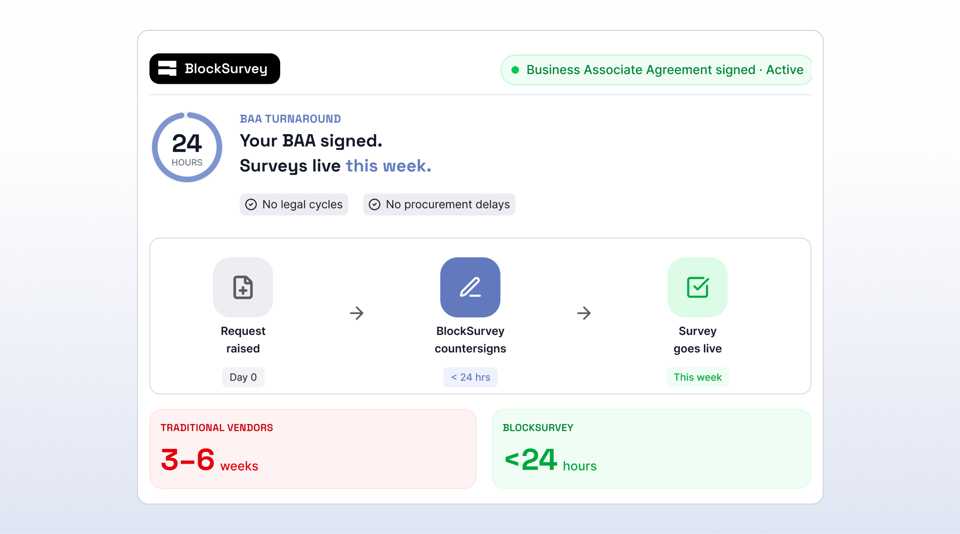
In 2024, OCR collected $9.9 million in HIPAA fines. If your product is compliant but your survey tool isn't, you have a gap. Every NPS survey, patient feedback form, and clinical research session that touches PHI needs a BAA. BlockSurvey signs BAA with their customers, so every response you collect is covered under HIPAA.

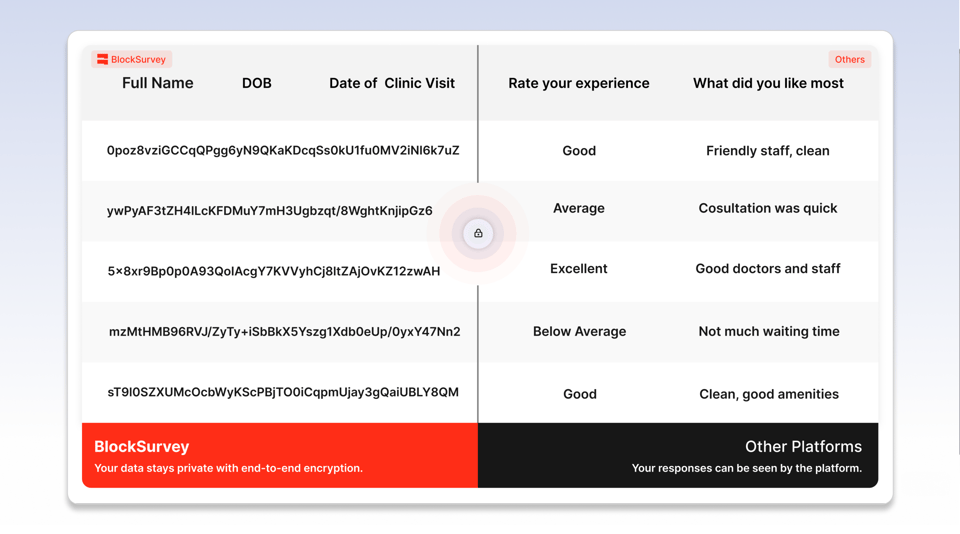
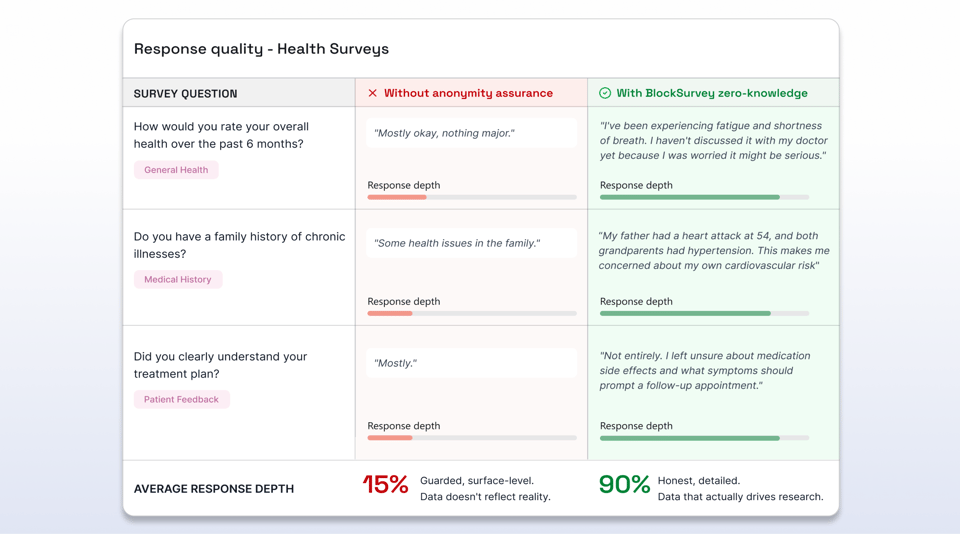
Healthcare users, patients, clinicians, care coordinators, are acutely aware of health data risks. BlockSurvey's zero-knowledge architecture means responses are encrypted on the user's device and can't be accessed by BlockSurvey or any third party. Users who know this share more accurately. Your product feedback reflects reality, not a filtered version of it.

Most survey tools bolt HIPAA compliance on as a premium tier. BlockSurvey was built privacy-first from day one, encryption is the architecture, not a feature layer. For healthcare SaaS teams, that difference matters. You're not paying for a waiver. You're using a tool that was built for this data.

Survey clinicians, care coordinators, and healthcare administrators on how they actually use your product: workflow friction, feature gaps, and usability issues that don't show up in analytics. End-to-end encryption means clinical users share candidly, knowing their feedback stays within your organisation.

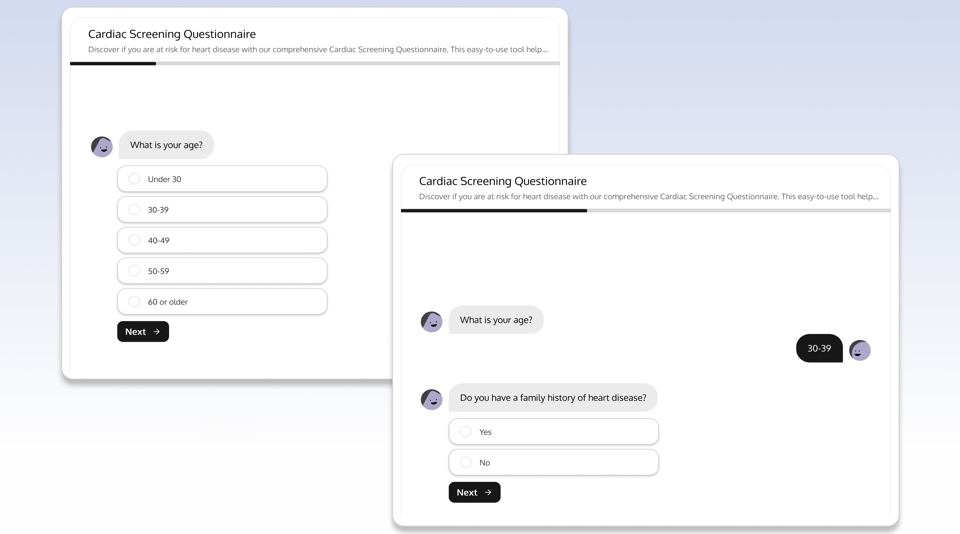
Collect patient satisfaction scores, post-appointment feedback, and digital experience ratings through HIPAA-covered surveys. AI conversational format reduces the clinical anxiety that traditional patient feedback forms create, patients share more honestly when the experience feels supportive, not administrative.

Before shipping a new clinical workflow or patient-facing feature, validate it with the users who will live in it. AI adaptive follow-up questions probe beyond the initial reaction, surfacing the workflow implications, edge cases, and unmet needs that shape whether a feature succeeds in a clinical environment.

Survey hospital procurement teams, clinical directors, and health system IT buyers on vendor evaluation criteria, switching triggers, and budget cycles. BlockSurvey's end-to-end encryption means commercially sensitive buyer insights stay within your organisation, not accessible to your survey vendor or their advertising partners.

Survey new clinical users and patient cohorts at key onboarding milestones: day 7, day 30, day 90. AI adaptive questioning identifies where users are struggling before adoption stalls. Drip campaigns automate the outreach sequence. HIPAA coverage applies throughout, from survey delivery to encrypted response storage.

Run NPS and CSAT programs across your clinical user base with full HIPAA coverage. AI follow-up questions automatically probe low scores for root cause, whether it's a workflow issue, an integration failure, or a training gap. Track satisfaction trends over time. Know where your product is winning and where it's losing clinical trust.
Start free. Upgrade when your research outgrows it. Every plan keeps end-to-end encryption and full data ownership.
$49$39/mo
Unlimited surveys with AI-powered creation, end-to-end encryption, and core privacy protections.
$99$79/mo
Everything in Standard, plus AI follow-up questions, custom branding, audience management, and custom survey links.
$149$119/mofor 3 users
Everything in Premium, plus AI data analysis, market research question types, campaigns, and compliance essentials.
Let’s Talk
For organizations that need scale, security, SSO, white-label control, and personalized onboarding.
Join 500+ happy customers worldwide who are already using our amazing product.
This platform goes far beyond basic surveys. I’ve used it for lead generation, landing page enrichment, and even embedded videos. Everything’s easy to use, well documented, and super flexible—whether you're building forms, quizzes, or something more advanced.
 Martin G.Créateur de la Méthode Rashōmon
I think BlockSurvey is good for short and long surveys. What I find the best is the fact that there are so many templates I can use and customize.
 Ankit M.AI Analyst Team Lead
Uses end-to-end encryption technology that allows users to create survey forms where data is secure and private. UI looks very beautiful.
 Lou F.Creative Visionary
From end-to-end encryption-level security and AI-generated questions to powerful logic flows and white-label domains, BlockSurvey has it all. It’s secure, innovative, and packed with features like calculations, templates, and in-app analytics. I use it to create personalized assessments for leadership training—nothing else compares.
 Kim B.Founder/ President - International Leadership Trainer
BlockSurvey puts privacy and security above anything else. The use of end-to-end encryption is not a gimmick as in many products; it's a core feature enabling privacy and security. The survey building tools are impeccable. I've used numerous SaaS survey tools, and nothing comes close.
 Trevor L.Chief Information Security Officer (CISO)
Big fan of BlockSurvey and what Wilson and the team are doing. BlockSurvey was the end-to-end encrypted product I signed up for and I love the UI, privacy, responsiveness, and transparency behind the platform. Great job all 'round and awesome to see it keep evolving.
 James Longley@jameslongley
Few tools combine data confidentiality and form aesthetics like this one. The conversational design improved my response rate by 43%, and the webhook integrations made syncing to our CRM effortless. I also love how responsive and community-driven the support team is.
 Kris R.Group Automation Manager
Creating surveys with BlockSurvey has been a breeze. The drag-and-drop interface is intuitive, and we’re able to collect data anonymously and securely—without intermediaries. It’s interactive, friendly, and encourages high participation while protecting user privacy. The reports are solid, and we’ve used it confidently for internal and external feedback.
 Liz D.IT Support Specialist
For our NGO, data privacy is everything—and this platform nails it. It keeps personal info fully protected while letting us design beautiful, chat-like surveys that increase engagement. Team collaboration features sealed the deal.
 Luis Noel D.Director Comercial
Using BlockSurvey to protect their respondents' privacy, increase their survey completion rates, get better community feedback, and build better organizations.
Join 500+ companies across 50+ countries who use BlockSurvey to collect sensitive health data securely, with the compliance coverage and privacy guarantees healthcare SaaS demands.