


.svg)



A game with no uncertainty can become dull very quickly. Tap the same button, get the same result, repeat until the screen feels dead. A game with too much uncertainty turns into noise. The player cannot tell what changed, which choice mattered, or what to try next. Good uncertainty in game design sits between those points. It gives the player something to wonder about, then gives enough feedback to make the next action feel informed.
That balance is worth studying because games are no longer a niche hobby. DataReportal’s Digital 2025 Global Overview Report notes that 92.6 percent of internet users aged 16 to 24 play video games, dropping slightly to 70.3 percent of users aged 55 to 64 and to 55.8 percent of online audiences over 65. That’s a pretty high proportion of the population in all age ranges, and the diversity of the player base creates a problem for game developers. Games now have to be legible to players with very different habits, using different devices, and with varying patience levels.
When Uncertainty Still Feels Readable
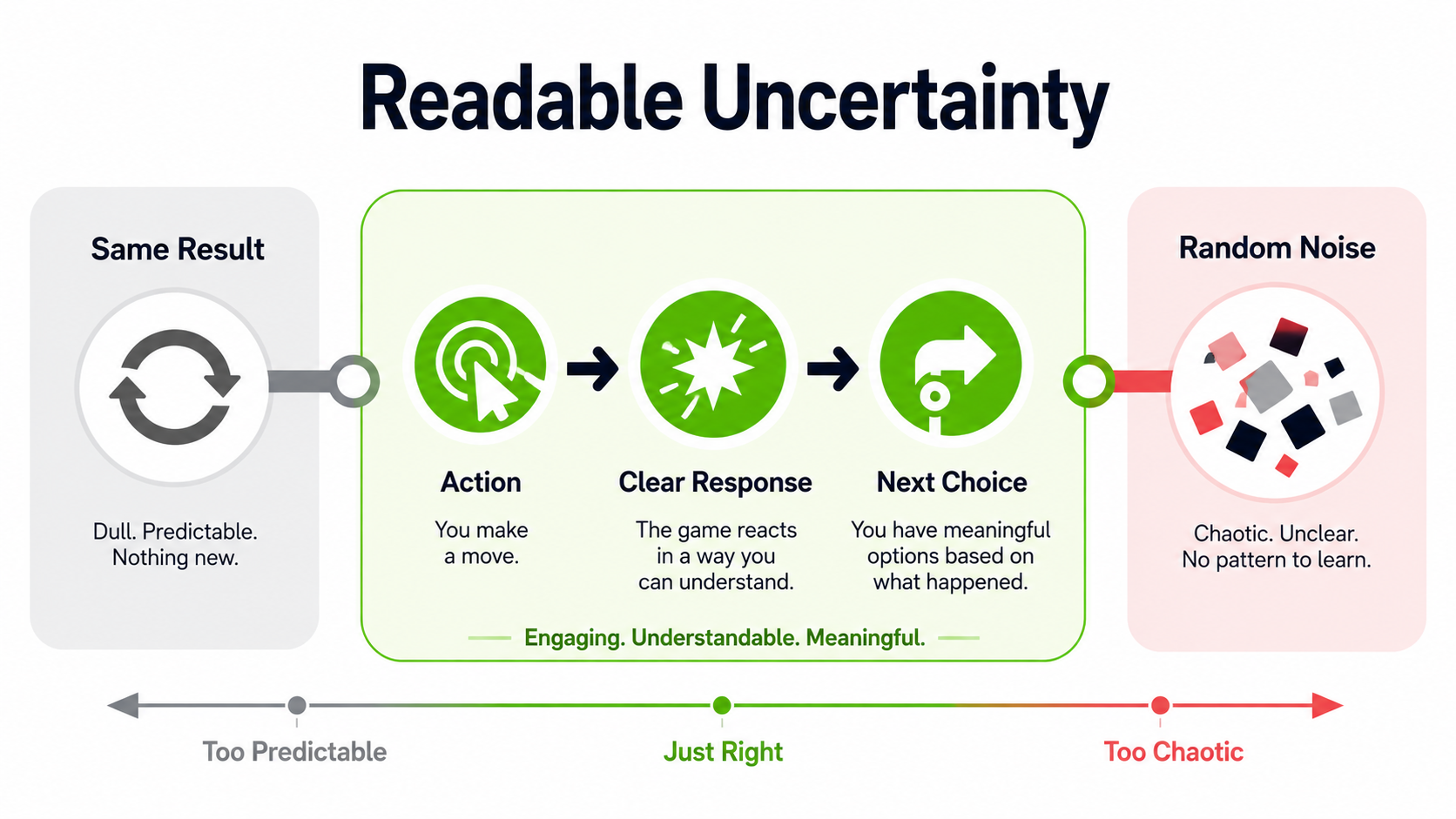
The clearest games teach through a small loop: action, response, adjustment. That loop can be fast or slow, simple or layered, but the player needs to see it. A racing game shows speed, drift, and collisions. A puzzle game shows the board state change. A card game reveals enough information for the next decision to make sense.
A useful place to see this idea in practice is an online slots casino gaming platform, where the format puts particular emphasis on the uncertainty and unpredictability of the games. The page presents slot games across familiar categories, including three-reel through seven-reel formats, themed games, new releases, and low and high volatility labels. Those labels are useful for understanding the feel of play because volatility describes how outcomes are distributed over time. A lower-volatility game tends to feel steadier because feedback appears more often in smaller forms. A higher-volatility game can feel quieter for longer, then change pace sharply.
The visible reel counts and volatility terms turn an abstract idea into something a reader can compare. The design lesson is not that one rhythm is better. It is that two games can share the same basic action while giving the player a very different sense of pace, anticipation, and feedback.
This short SlotsLV explainer on low-volatility games follows the same thread in plain terms. It separates volatility from RTP, explains hit frequency, and shows why a game can feel steadier without becoming predictable. For readers new to the term, that distinction is often the missing piece. RTP is a long-term mathematical measure. Volatility is closer to the felt rhythm of a session. Know more about Low Volatility Slots
Unknown Is Different from Unreadable
Uncertainty makes a game feel alive when the player understands the shape of it. A shuffled deck, a hidden enemy path, a randomized item drop, or a changing puzzle board can all create tension without turning play into guesswork. The player does not know the exact outcome, but they understand the range of possible outcomes.
Unreadable design feels different. The same input seems to create unrelated responses. Visual cues arrive too late. The game punishes a choice without showing why. Learning gives way to guessing.
Feedback Gives Chance a Shape
Good feedback does not remove uncertainty. It makes uncertainty readable. A health bar gives the player an idea of how much longer their character can hold out, even if they don’t know exactly how much damage each attack will cause. A short sound cue can confirm that an action landed. A glow around an object hints that it is important. Clear signals give surprise a shape.
Small signals matter most in games with repeated actions. If each round, tap, or move gives no useful information, repetition becomes flat. If each response teaches something, repetition becomes a way to read the system. This is why many casual games rely on quick visual changes, short animations, and clear score movements. They keep the player oriented without needing a long explanation.
There is also a timing issue. Feedback that arrives instantly can feel satisfying, but it can also become clutter. Feedback that arrives later can work if the game has already trained the player to wait for it. Strategy games, puzzle games, and role-playing games often stretch the loop. Arcade and mobile games usually tighten it.
Challenge Should Move at the Player’s Speed
Making a game feel fair is a matter of balance. This can be achieved through level design, matchmaking, enemy behavior, scoring, timers, or difficulty settings.
Readable uncertainty is the reason a simple game can stay interesting, and a complex game can stay approachable. The screen does not have to explain everything. It has to give the player enough information to keep forming expectations, testing them, and revising them. That is also where adaptive systems are heading: matching challenge to skill closely enough that players stay engaged without feeling lost, a point reflected in MDPI’s Applied Sciences study on dynamic difficulty adjustment and player engagement.
How Games Use Uncertainty Without Confusing the Player FAQ
How do games use uncertainty to keep players engaged?
How can uncertainty in games enhance the overall gaming experience?
Are there specific techniques that game developers use to introduce uncertainty without confusing players?
Can uncertainty in games lead to frustration for players?
Get insights.
Unlock value.
- 14-day free trial
- Set up in minutes
- End-to-end encrypted